Cowboy State Daily…Your Bias Is Showing Again

Cowboy State Daily’s political bias was once again on full display as writer Clair McFarland tried to put together a hit piece to protect favored political allies. 

Ms McFarland was tasked with reporting on an issue with the Wyoming Legislative Service Office and their admitted quarantining of constituent emails to lawmakers, as detailed in this report.  However, as is too often the case with Cowboy State Daily reporting, rather than being the watchdog for the people, they play lapdog to the establishment class and special interests in Cheyenne.

Why side with the establishment?

That question naturally follows. Why target a conservative grassroots organization representing thousands of voters while ignoring entrenched, well-funded influence groups?? You don’t see Cowboy State Daily or senators like Bo Biteman and Tara Nethercott going after any of the DC Affiliate groups like the Wyoming Education Association, Wyoming Medical Society, Wyoming Hospital Association or all the other special interest groups that have had a stranglehold on Cheyenne for decades.   


More curious still is what McFarland failed to disclose. Wayne Hughes, the owner of Cowboy State Daily and a California billionaire who relocated to Wyoming in 2017, is now one of the state’s largest political spenders. His Wyoming Hope PAC was Tara Nethercott’s second-largest campaign donor. That connection went entirely unmentioned.

With facts like these omitted, it raises an unavoidable question: are Wyomingites’ best interests truly being served, or are we watching yet another political game play out behind the scenes?

An Age Old Game of Political Spin

The tricks of the spin trade were on full display starting in the first sentence, where McFarland claims that “the Legislature’s highest-ranking members rejected a controversial bill to keep a list of emails people send to legislators.”  When in reality it was a tie vote, with more high-ranking members voting for the bill than against it. Those in favor included the Speaker of the House, the Vice President of the Senate, the Majority Floor Leader, Chair of the House Appropriations Committee, and the Speaker Pro Tempore.  

Further, she opens the article with a blatant misunderstanding of the issue at hand, stating “a controversial piece of legislation that would require legislative staff to keep a rolling list of emails people send to legislators” Did she even read the bill? Because this is factually inaccurate: the bill was not requesting a rolling list of individual emails that are sent to lawmakers. It requested the following, all related to domain names and addresses and only those that were being quarantined:

  1.  The LSO publish a list of all domain names and addresses that are being quarantined or prevented from delivering email to legislators in any way.
  2. Any person whose email communications to legislators that had been quarantined would be able to contact the LSO to request that their emails be removed from quarantine and delivered to legislators. 
  3. The LSO would remove requested domain names or addresses from quarantine unless the release from quarantine or allowed delivery posed an actual security threat to the information technology systems of the state of Wyoming.

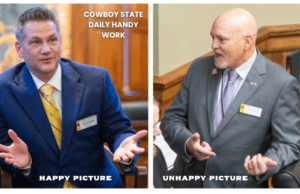
After this disingenuous introduction, CSD immediately placed the following image to influence reader opinions to their advantage.  On the left, a smiling image of Senator Bo Biteman, who voted down the legislation. On the right, Representative John Bear (who voted in favor) mid argument and seemingly unhappy.   Manipulation that is all too familiar in today’s biased mainstream media.
Of the quotes and statements McFarland chose to incorporate into her article nearly 70% were focused on making the case to support the lawmakers opposing the bill.  Continuing on this tilt, McFarland spoke with 3 of the 5 lawmakers that opposed the bill to get their opinions.  This included Senators Biteman, Gierau, and Nethercott. And yet it appears she talked with 0 of the lawmakers that voted for the bill.  She goes on to quote Biteman over 6 times in the article – giving him an outsized chance to support his manipulation of words while failing to ask him how to explain Director Obrecht’s email. 

She even added Biteman’s false statement that Honor Wyoming uses a bulk email service, and that the legislative system rightly classifies that output as spam.  This is not true and she did not even ask us if it is true during our interview (more on that below).  Saving that falsehood as another “misinformation” tool on her part.

As for Nethercott? She quotes the senator 12 times, allowing unfettered access to attack her opponents with zero push back on any of her claims.  Like “Wyoming being taken over by large political well funded organizations”.  But for Nethercott, this only applies to one class of organization, the ones that give a voice to the average conservative voter.  Anybody that doesn’t toe the establishment line. 

Sen. Nethercott also made this false statement, insinuating that Honor Wyoming is using a platform “that doesn’t allow them to reply back to you.”  This is utterly untrue and again, Ms McFarland did nothing to verify the truth of this as that would undermine her biased story and preferred outcome of supporting the establishment. 

The truth? Honor Wyoming uses one of the most popular and trusted civic advocacy software tools in the country, Quorum.  The same software system used by thousands of nonprofits to deliver emails to lawmakers in almost every capitol of every state in America.  Without censorship concerns.  The same platform other nonprofits in Wyoming use that were also being quarantined.  The system requires the voter to enter their name, personal email address and zip code.  Their email is then sent on behalf of the constituent to the lawmaker(s) using the personal information provided so when (or if) the lawmaker responds, the exchange is a private communication between the lawmaker and constituent’s private email.  

When Honor Wyoming was given the opportunity to answer questions, the story line was already baked

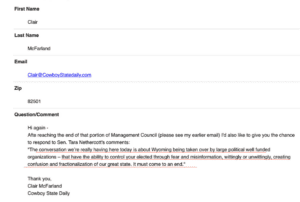
But it gets better.  McFarland admitted during one of our phone calls with her that she had been texting with Biteman during the session.  Conveniently it seems her storyline in favor of those opposing the bill was ready to go before doing any research or talking with any stakeholders and all before the hearing was even finished.  Let that sink in….the story line was apparently baked before any investigative journalist efforts might have been attempted (they weren’t).

McFarland reached out to Honor Wyoming, sending two separate emails that showed her cards a bit early. The questions she wanted to entertain during our call with her had nothing to do with the LSO’s letter showing that emails were in fact being quarantined.  They really had nothing to do with the issue at hand at all. 

-Nothing to do with the possibility of a need to protect the free speech of thousands of Wyoming voters.  

-Nothing about the 2,000 petitions that were signed by concerned citizens. 

Instead, she zeroed in on deflecting from the real issue by helping Biteman and Nethercott prop up their Biden-esque efforts to characterize anything they disagree with as disinformation.  
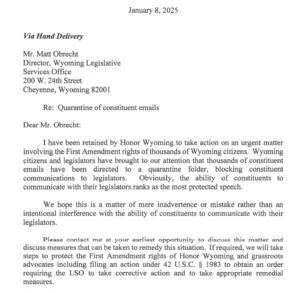
But we must give McFarland some credit.  She did a commendable job helping Nethercott and Biteman in their efforts to twist definitions and words to try and hoodwink the public into thinking nothing is amiss.  The simple reality is that the LSO was blocking certain constituent emails from reaching their lawmaker’s actual inbox. Yet both Senators feverishly made the claim that no emails have been blocked or censored and that any statements to the contrary are dangerous disinformation campaigns.  Here is LSO Director Albrecht’s email clearly stating emails were being quarantined.  Oops.
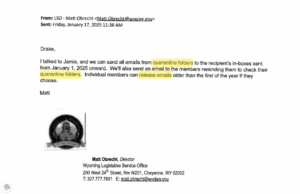
Did the storyline change when presented with LSO Director’s email admitting that they were in fact quarantining constituent emails? Sadly not. McFarland had access to this document and yet decided to support a false narrative by including quotes from Nethercott such as “the effort sprang from a falsehood that legislators aren’t receiving emails. That is factually wrong and they know it.”  

Or promoting statements like “We’ve established the fact that no emails have been blocked,” by Biteman with no push back.  A real disservice to the people of Wyoming to say the least. 

Instead of addressing the legitimate quarantine concern, Biteman and Nethercott wanted to play word games and demonize anyone that dared to opine that quarantining communications without someone’s knowledge is a form of censorship.  It was a failed attempt at trying to manipulate terminology to fit their political agendas.  Something the public has long lost patience for.  You know the drill, redefine what a woman is.  Change the definition of a vaccine. Coming to America illegally is not a crime if we say so.  It’s the same old game.  Now we can add that blocking communications is somehow not a type of censorship.  Even Zuckerberg would be proud.   


Simple Journalistic Research Would Have shown the truth

If McFarland had looked at the evidence and just done a quick search for the common definition of these simple terms, she would have found the following:

Quarantined emails are messages flagged by security filters as potential spam, phishing attempts, or malware, which are isolated in a secure, separate area rather than being delivered to the user’s inbox. 

Censorship is the suppression or removal of writing, artistic work, etc. that are considered obscene, politically unacceptable, or a threat to security.

What have we learned with even a few minutes of research? Censorship is the suppression of communications.  Quarantined emails are messages that are being suppressed.  Wait for it……quarantining emails is a form of censorship.  

An inconvenient truth for Biteman and Nethercott, but a truth all the same. 

With the evidence provided, thousands of petitions signed by concerned citizens, and support by “high-ranking” prominent lawmakers, McFarland still decided to try and help spin the issue as a conspiracy theory and disinformation campaign.  She does this on behalf of the establishment class, siding against the people’s interests.   

We’ve seen this play out time and time again across America since Covid.  But the good news is that independent media voices and grassroots organizations have turned the tide on establishment politicians and legacy media’s previous monopoly on news narratives.  And that’s what these folks are really upset about.  
 

It’s Time To Turn The Page on the Wyoming Library Association

In 2022, the Campbell County Public Library board voted to withdraw from the American Library Association (ALA) and its affiliate, the Wyoming Library Association (WLA).

It’s time for the rest of Wyoming’s libraries to do the same. In Wyoming, a state where registered Republicans outnumber Democrats nearly 10-1, the WLA serves as the ALA’s local propagandist. They explicitly promote DEI, critical race theory, anti-police progressive activism, and opposition to capitalism. All things that go against the clear preference for conservatism in Wyoming.

The Wyoming Library Association does not develop these priorities on its own. It follows the direction set by the ALA, which was founded in 1876 with the commendable mission of promoting libraries and librarians.Over time, however, the ALA’s focus has shifted and it has been overtaken by ideological activism. Rather than focusing on the core mission of libraries—education, intellectual development, and the preservation of cultural heritage—the ALA increasingly devotes its energy to political advocacy. In practice, that has meant prioritizing the defense of explicit LGBTQ-themed materials for minors over the legitimate concerns of parents and communities, reinforcing the very agenda Wyoming voters have consistently rejected.

Libraries have long played an important role serving Wyoming communities, but like so many once-revered institutions, they now champion values at odds with the communities in which they reside and serve.

The WLA rallies against commonsense laws 

Here in Wyoming, lawmakers are debating a bill that would allow community members to sue libraries that allow sexually explicit material in sections of the library open to kids.

The WLA has come out swinging against the bill, apparently convinced that it is, in fact, the duty of libraries to make porn and other inappropriate content easily accessible to kids. WLA president Cristine Braddy argues that restricting minors’ access to inappropriate material constitutes a “ban,” as if banning children from inappropriate material is a bad thing.

You might wonder how we got to the point at which Wyoming’s association of librarians would fight a bill that seeks to protect children’s innocence.

The answer lies in the WLA’s close association with the ALA.

The ALA isn’t hiding the ball 

At the October 2022 Campbell County Public Library board meeting when residents debated staying affiliated with the ALA and the WLA, one resident declared that the ALA exists to “to promote reading, libraries, library professionalism. They’re not a political entity.” 

State and community libraries in Alabama, Florida, Montana, Missouri, Texas, and elsewhere would beg to differ. These states cut ties with the ALA starting in 2022 over its explicit support for age-inappropriate books for kids, DEI, and other progressive values. In 2023, the Florida Department of State, which manages the state’s public libraries, prohibited libraries from accepting grants from the ALA. In other words, a growing number of states have concluded that the ALA’s activities extend well beyond promoting libraries and reading.

The ALA has not attempted to conceal its ideological orientation, a fact illustrated by its recent leadership. In June 2022, shortly after being elected ALA president, Emily Drabinski tweeted, “I just cannot believe that a Marxist lesbian who believes that collective power is possible to build and can be wielded for a better world is the president-elect of @ALALibrary.”

It is difficult to imagine the organization extending the same enthusiasm to a president who publicly identified as a conservative Christian in support of capitalism. The contrast highlights the narrow range of viewpoints that appear acceptable within the ALA’s leadership culture.

Drabinski led the organization until July 2024. Her public framing of the role reflects an understanding of the ALA presidency as a vehicle for advancing a particular political worldview, rather than as a neutral professional position.

 The ALA’s current president is Sam Helmick, a “nonbinary, aromantic, asexual” who uses “they/them” pronouns. As with prior leadership, these self-descriptions are accompanied by a public embrace of contemporary progressive identity frameworks that increasingly shape the organization’s culture and priorities.

The WLA’s woke values

The name “Wyoming Library Association” suggests a neutral, professional organization that represents staunchly conservative WY. Yet a review of its public record and website shows that it consistently promotes progressive ideological positions more commonly associated with national advocacy groups than with a statewide library association

Would an organization that sought to reflect Wyoming’s conservative values and love of country adopt an “Equity, Diversity, & Inclusion” statement that trashes America as a fundamentally racist nation, finds nothing redeeming in its history, and pushes critical race theory as a solution?

The statement is worth quoting at length:

“The Wyoming Library Association acknowledges that systemic racism and discrimination has harmed people in our communities, across our state, our country, and internationally…With this knowledge, we will dismantle these structures and build equitable, diverse, and inclusive systems…The nation’s history of settler colonialism and slavery, along with its capitalistic structures and beliefs in rugged individualism imposed on the land, serve as the foundations to Wyoming’s vast and textured human landscapes.”

The WLA’s “EDI” (which is just DEI with the letters re-arranged) committee page includes resources on “microaggressions”, “critical race theory,” links to writings by arch-race hustler Ibrim Kendi (who spoke at the ALA’s 2023 annual conference), an endorsement of the 1619 Project, which places slavery at the center of the American founding, and resources for those wishing to “confront race, policing, and mass incarceration.”

If ideological activism is truly waning, as some have claimed, the WLA hasn’t gotten the memo.

Whatever claims are being made about the decline of ideological activism in public institutions, the WLA’s own materials make clear that it remains fully committed to it.

In search of banned books

The WLA’s opposition to the bill that would force libraries to keep inappropriate material far from children makes sense in the context of the ALA’s favorite cause—”banned” books.

Each year, the ALA releases reports claiming that books are being banned across the country, prompting widespread media coverage. Portraying these disputes as censorship has become a powerful tool for generating attention and influence.

The ALA presents itself as a defender of public access to books, warning that efforts to limit certain materials are part of a broader push to restrict what Americans can read. If widespread government censorship truly existed, opposing it would be a cause most Americans could agree on. Governments should not be in the business of suppressing books, and efforts to ban ideas outright would raise serious First Amendment concerns.

But that is not what is happening.

One concern is how the ALA defines the term “ban.” When someone files a complaint against a book, the ALA counts that in its statistics, even if the challenge is unsuccessful and the book stays on shelves. In the event that the library does remove a book from circulation in response to a complaint, it’s still not clear that “ban” is the most apt word. If the book is widely available in brick-and-mortar bookstores, online sellers like Amazon, and other library systems, is it accurate to say the book is banned?

Historically, banned books were truly inaccessible. When a book was banned in the Soviet Union, you risked imprisonment—or worse—if you tried to get your hands on it.That is not the situation in the United States today.

A bigger problem with the ALA’s methodology is that, as its own data indicates, the majority of the so-called censorship efforts involve books marketed to children or teens. Several of the ALA’s top 10 “most challenged books of 2024” are, for example, young adult books thick with LGBTQ themes. Gender Queer  the second most challenged book of the year, is a graphic novel that includes explicit sexual imagery, references to sex acts, and detailed discussions of masturbation and other adult topics.

The ALA wants to make the debate over books like Gender Queer about censorship, but it’s really about whether kids should have access to sexually explicit material. The answer is obviously no, and libraries have a duty to protect kids from inappropriate material.

By opposing even basic restrictions on sexually explicit content in youth sections, the Wyoming Library Association aligns itself with national advocacy positions blatantly opposing the values of many Wyoming families. Libraries should be safe, welcoming spaces for children and should prioritize education and literacy over ideological messaging.

Our librarians are experts at reading books—now they need to read the room and close the chapter on the WLA and ALA.

The Wyoming Hospital Association’s War Against Patients

This past legislative session, Wyoming Hospital Association (WHA) President Eric Boley marshaled his organization’s resources to sink a sensible bill that would have required hospitals to be up front about the prices they charge patients. Boley, who runs one of Wyoming’s most powerful lobbying groups, had a creative explanation for why Wyoming families pay exorbitant healthcare costs:

“The consumers aren’t working with their insurance companies,” he grumbled. “They’re not finding out what their payments are.” 

In other words, you are the problem. It’s not that the Wyoming healthcare system is a tangled bureaucratic mess of overlapping providers, pharmacies, public and private insurance plans, and government agencies. It’s not that many Wyoming hospitals have been found to be out of compliance with federal price transparency requirements.

No, the problem is supposedly Wyoming citizens who fail to devote enough unpaid time and expertise to navigating a system so convoluted that even the institutions running it cannot fully explain how their own prices are set.

The WHA works hard to keep it that way. A ubiquitous presence in Cheyenne each legislative session,the WHA consistently aligns its advocacy with the policy priorities of the American Hospital Association (AHA), one of the nation’s most powerful healthcare lobbyists. This alignment has the effect of preserving high prices, limiting competition, and reducing price transparency for Wyoming families.

Here’s what you should know about these insidious organizations and their influence in Wyoming politics. 

What is the AHA?

The American Hospital Association describes itself as “national organization that represents and serves all types of hospitals, health care networks, and their patients and communities.” It regularly spends millions each year to oppose federal legislation that it sees as threatening to hospitals’ bottom line. Founded in 1898, it has been a consistent force in American politics. Consistent, that is, at working for laws that enrich its members and make the healthcare system more confusing and less affordable for everyone else. 

As the state affiliate of the ALA, the WLA closely follows the direction of the national organization. The ALA advances its priorities at the federal level, while state affiliates carry those same priorities into state and local policy debates. This structure allows the ALA to function as a centralized advocacy organization, with affiliates like the WLA promoting its goals within Wyoming.

The AHA says it serves “all types of hospitals, health care networks, and their patients and communities,” but its advocacy has resulted in few wins for patients.  To understand the WHA’s approach in Wyoming, it helps to examine the national policy priorities of its parent organization. The AHA was one of the driving forces behind Obamacare. This objective was self-serving, as described by National Review’s Kevin Glass: “What the AHA wanted most was to preserve the flow of government money to its member hospitals, especially through Medicare and Medicaid. In exchange, the AHA agreed to the $155 billion in payment cuts, spent incredible sums of money on lobbying, and steered most of its campaign donations toward Democrats.”

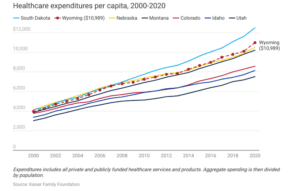
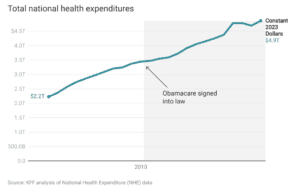
And how has that worked out? Since 2010, when President Barack Obama (D) signed Obamacare into law, total U.S. healthcare spending has increased roughly 40%.

This year, in line with its previous support for Democratic Party healthcare priorities, the AHA opposed President Donald Trump’s One Big Beautiful Bill Act (OBBB). The AHA cunningly framed its opposition as a concern for patients it claimed would lose insurance coverage due to the legislation, but reading between the lines shows its real worry was that hospitals would receive less government funding. 

As a lobbying organization that represents large, often profitable hospitals, the AHA’s support for Democrat healthcare policies is unsurprising. Those policies tend to emphasize expanded public spending through programs like Medicare and Medicaid, which reimburse hospitals for services provided. Increased funding reliably benefits hospital systems financially.

What this approach does not necessarily emphasize is whether higher spending has led to better outcomes for patients. Despite rising healthcare costs, many Americans continue to experience longer wait times, higher out-of-pocket expenses, provider shortages, and uneven quality of care. The incentive structure rewards hospitals for volume and reimbursement, not for improving results. In that context, the AHA’s focus appears less centered on system performance and more on protecting the financial interests of its members.

The AHA and the WHA work together to quash competition

Capitalism benefits consumers by lowering prices and increasing quality, and it does this through market competition. If businesses have to compete against each other, they’re more likely to make choices with consumers in mind. The alternative, of course, is to go out of business.

The AHA opposes competition. Instead, the AHA lobbies for laws that protect its members from the competitive pressures that most other businesses face.

It has been highly successful at that goal. 

Over the last few decades, the hospital sector has become more consolidated and less competitive, leading predictably to higher prices and lower quality of care. Multiple studies suggest that as hospitals merge, becoming larger but more impersonal, patient mortality actually increases! 

Who is behind the decline in competition between hospitals? You guessed it—the AHA. In 2010, for example, the AHA successfully lobbied Congress to include in Obamacare a provision effectively banning the creation of new physician-owned hospitals. Before 2010, the number of physician-owned hospitals had been increasing to meet our aging country’s growing demand for healthcare services. Established hospitals, rather than compete with these smaller and more community-oriented providers, demanded to the tune of millions of dollars that the government protect them from competition—and lawmakers obeyed. The AHA now spends millions of dollars each year to keep the ban in place.

Another way the AHA protects its members from competition is through Certificate of need (CON) laws, which require state officials—such as a health planning agency—to approve new healthcare facilities or expansions. The AHA began lobbying for states to adopt CON laws in the 1960s and 1970s. At best, CON laws are unnecessary—competition, not bureaucrats, should decide if a given market can support a new or expanded hospital. At their worst, CON laws encourage the largest and most powerful hospitals in the state to curry favor with the bureaucrats charged with authorizing new certificates. Unsurprisingly, the big players, those with the most money, tend to have their way, commonly resulting in the denial of certifications.  

At the start of 2025, Wyoming was one of 36 states with a CON law. In Wyoming’s case, the CON law applied to nursing homes. Some  lawmakers have tried to repeal the law in 2024but the WHA has, like a fox guarding the henhouse, nipped those efforts in the bud. It was not until 2025 that lawmakers successfully passed HB 289, allowing for proper competition in nursing homes. 

Less transparency, fewer beds, higher profits

Although the federal government has required hospitals to post their prices (prompting the AHA to unsuccessfully sue), most have dragged their feet or made only half-hearted attempts to comply. 

More states are moving to pass their own price transparency laws, including Wyoming. Unfortunately, those efforts have not always been successful due to lobbying by groups like the AHA and WHA. 

Wyoming’s HB 121, sponsored in 2025, would have required hospitals to maintain and make public a list of standard charges for items and services. HB 121 passed the House but failed narrowly in the Senate. Another unfortunate victory for WHA’s lobbying. 

Wyoming families pay some of the highest healthcare costs in the region. Boley could use the AHA’s considerable resources to pressure hospitals into being more transparent about the prices they charge insurance companies and individuals, but he’d rather blame patients.

Incredibly, the number of hospital beds in Wyoming has decreased over time as the state’s population has grown, from 3.8 beds per 1,000 people in 1999 to 3.25 in 2023. In aggregate, Wyomingites are not only spending an increasing portion of their income on healthcare—they’re getting less in return over time. This should be a five-alarm fire, a turning point moment for organizations like the WHA that purport to take the Hippocratic Oath. 

And what do we hear from the WHA about all of this? Crickets.  

Wyoming or D.C.? 

In its 2023 legislative recap, the WHA wrote: “Too often during the session we heard a narrative characterizing hospital [sic] as ‘big business’ or money hungry or as an arm of the federal government.  This sentiment is a real challenge, which cannot be ignored and requires a concerted response.” 

In other words, the WHA admits it has a PR problem. And why is that? If you’ve made it this far, you know it’s because the WHA’s lobbying history and its close relationship to the AHA paint a clear picture of an organization working in lockstep with outside interests to protect hospitals at the expense of Wyoming families. It’s that simple.  

Like the Wyoming chapter of the American Academy of Pediatrics (AAP) and the Wyoming Medical Society (WMS), the WHA’s allegiance is to D.C. and the large corporations who fund these organizations. Not the people of Wyoming, and certainly not to our state’s conservative values. When well-heeled outside interests use the levers of government to benefit the few at the expense of the many, it’s obvious the system isn’t working as it should.

That’s where we come in. Join us as we build a movement dedicated to restoring integrity and transparency in Wyoming politics—starting with exposing the interlopers pushing D.C.’s soulless values on us. 

How National Medical Lobbyists & Their Wyoming Operatives Tried To Steer The Pediatric Transgender Debate

Even though Wyoming is a deeply conservative state, full of sensible people who know the difference between boys and girls, transgender ideology has nevertheless reached our borders and become a divisive issue in our politics. Who is to blame for forcing these manufactured narratives on us?

Although there are many culprits, one of the most visible is the network of medical groups with Wyoming-sounding names. They present themselves as neutral, patient-centered providers, but in reality act as lobbyists for national progressive organizations.

The Wyoming chapter of the American Academy of Pediatrics (WY-AAP) is a textbook example of how national agendas are funneled through local groups to stifle local dissent.  

 Pediatrics or Politics? The AAP’s Troubling Priorities

The WY-AAP is the state affiliate of the American Academy of Pediatrics (AAP), the nation’s largest professional association of pediatricians. Despite its respectable-sounding name, the AAP is led by progressives who oppose parental rights and promote so-called ‘transgender healthcare,’ a practice many view as quack medicine.

In July 2025, the AAP announced its support for eliminating all non-medical childhood vaccine exemptions, effectively telling families that the abstract notion of ‘public health,’ the same banner used to justify a host of coercive pandemic policies, outweighs parents’ right to make medical decisions for their children.

The AAP’s  hostility to parental rights might seem puzzling at first, but it all becomes clear when you look at the money. The AAP is funded by the largest pharmaceutical corporations in the world, including Pfizer and Moderna. In other words, the AAP’s stance on vaccine exemptions and its implacable support for giving babies as young as six months old the mRNA vaccines is less about medicine and more about business for its members and sponsors.

“It should come as no surprise, then, that the AAP is also one of the most vocal and influential defenders of “gender-affirming care” for what they call “transgender and gender-diverse children and adolescents.” The AAP promotes the use of drugs to stop otherwise healthy kids from going through puberty and pumping them full of hormones from the opposite sex, even as the countries in Europe that pioneered so-called transgender care have begun to take a more cautious approach

Incredibly, the AAP published an article in 2023 that even sought to portray the withholding of transgender care as a form of child maltreatment. This designation could trigger child protection investigations in some states.    

This, from the nation’s largest association of pediatricians—67,000 members whose mission is supposed to be safeguarding children’s well-being.

The WY-AAP Marches In Lockstep With Its National Headquarters

If anyone believes the AAP’s state chapters reflect local values, the conduct of the WY AAP during debate over SF 99 should put that notion to rest. SF 99, known as Chloe’s Law, prohibits doctors from administering puberty blockers, cross-sex hormones, or performing surgeries for the purposes of facilitating gender transitions. SF 99 was signed into law in March 2024. 

Wyoming’s woke medical groups, including the Wyoming Medical Society (WMS) and the WY-AAP, rallied to defend transgender procedures. They lobbied, they testified, and they raised a loud outcry against the bill, fighting to preserve chemical and surgical mutilation of children.

Dr. Mike Sanderson, the Sheridan-based pediatrician and president of the WY-AAP, sat before lawmakers during testimony and lambasted supporters of the bill,accusing them of interfering in the doctor-patient relationship. Sanderson should know that if doctors are harming children in direct violation of the principle of beneficence (otherwise known as the Hippocratic Oath), then it is the responsibility of lawmakers to stop them. 

Emails show WY-AAP Leadership Dismissing Opposing Views

Emails from WY AAP president, Sheridan pediatrician Dr. Mike Sanderson, reveal how doctors tied to national progressive organizations use their credentials to dismiss and marginalize conservative perspectives. The clearest example came in early 2024, during the heated debate over SF 99, in an exchange with Dr. Eric Cubin that Honor Wyoming obtained.

Cubin, a radiologist who supported the bill and served on the Wyoming Board of Medicine at the time, reached out to WMS leadership to question whether its public opposition to SF 99 truly reflected the views of its members. In his emails, Cubin diplomatically suggested the organization should refrain from taking a position on hot-button topics like transgender medicine or, at the very least, poll members to see where they stand. 

Cubin goes on to point out that a different national pediatric group, the American College of Pediatricians (ACPeds), opposes the use of puberty blockers, hormone therapy, and surgeries because there is no long-term evidence to support those interventions. 

How did Sanderson respond to a group challenging his progressive worldview? Predictably, “[I]t is widely apparent to nearly everyone in the field of Pediatrics that the American College of Pediatricians is the politically motivated organization,” Sanderson sneers. He goes on to write, “They are not taken seriously amongst the vast majority of pediatricians.”

Well, there you have it. Sanderson’s appeal to the “vast majority of pediatricians” echoes the same rhetorical playbook progressives employed during the pandemic, when they routinely claimed that most scientists supported masking, mRNA vaccines, school and church closures, and exempting left-wing protesters from lockdown restrictions. 

But this cheap appeal to consensus is not the slam dunk Sanderson thinks it is. After all, many scientists were wrong about pandemic-era public health policies and the origins of the virus. Furthermore, scientists, doctors, and public health officials actively suppressed and censored dissenting experts, making it appear as though a consensus existed when it did not. 

Cubin’s Defense of Wyoming’s Children Came At A Professional Cost.

During the debate over SF 99, Cubin emailed members of the Wyoming House of Representatives, warning that WMS leadership had “been essentially hijacked by the far left” and that their opposition to SF 99 did not reflect how many WMS members feel. For this courageous act, Gov. Gordon removed Cubin from the Wyoming Board of Medicine, punishing him for expressing his personal opinions. Meanwhile, Wyoming’s most powerful medical groups remain led by people like Sanderson, who cloak themselves in the authority of ‘science’ to silence dissent while pushing an ideology that denies biological reality and runs contrary to Wyoming values.

Pay Attention to the Fruit

The fight over Chloe’s Law made one thing painfully clear: groups like the WY-AAP are not independent Wyoming voices, but conduits for national lobbying interests. Their leaders dismissed dissent, lobbied against parents, and aligned themselves with outside organizations that were more interested in advancing their ideology than protecting children.

When Wyoming parents and lawmakers raised concerns, they weren’t met with honest debate. Instead, they were waved off with appeals to authority and consensus, the same tactics that masked so many failures during the pandemic. Meanwhile, those willing to challenge the system, like Dr. Eric Cubin, paid the price for speaking out.

This pattern should remind us to look beyond the branding and rhetoric. A local-sounding name does not guarantee local values. The real test is the fruit. And when we look at the fruit of the WY-AAP (the lobbying, the dismissal of parental rights, the allegiance to pharmaceutical dollars and progressive ideology….)it’s plain enough: what they’re offering Wyoming families is rotten.

Wyoming Medical Society Chooses Woke Medicine Over Wyoming Families

One of Wyoming’s oldest and largest healthcare lobbyists opposes conservative values and represents the interests of the largest healthcare companies in the world. 

And who is that? Allow us to introduce you to the Wyoming Medical Society (WMS).  

Founded in 1903, the WMS states that it “serves our membership, and their patients, and works to improve the health of Wyoming’s citizens.”  In practice, however, the WMS often functions less as a champion of patients and physicians in Wyoming and more as a vehicle for advancing left-leaning healthcare policies while boosting the profits of large, out-of-state pharmaceutical companies, insurers, and other players in the medical-industrial complex.

The WMS maintains a constant presence in Cheyenne during each legislative session, working aggressively behind the scenes to influence lawmakers and shape the fate of key bills.  As we inch closer to 2026, when Wyoming’s lawmakers will return to Cheyenne for a new term,  it is critical to make clear—loudly and widely—that the WMS is not acting in the best interests of Wyoming residents.

Birds of a feather

Although the WMS claims to be an independent organization, in reality it is closely aligned with the American Medical Association (AMA), the largest healthcare lobbyist in the country.The WMS sends delegates to participate in the annual meeting of the AMA’s House of Delegates, where members adopt official policies. The WMS and the AMA have a long history of collaborating on initiatives. Recently, WMS President Sheila Bush shared the stage with the AMA’s senior legislative attorney at a gathering in Maryland. These close connections make it clear that the WMS and AMA truly are birds of a feather.

Let’s be clear about the AMA. The AMA has been a—perhaps the—leading national torchbearer for youth transgender medicine and abortion rights for years. Former AMA President Jack Resneck Jr. said it was “disinformation” to claim hospitals are performing sex change surgeries on teens, while urging them to continue providing broader “gender-affirming care.” Yet according to Do No Harm, an organization that tracks pediatric sex change treatments, doctors performed nearly 6,000 sex change operations on minors between 2019 and 2023. So who, exactlywas spreading disinformation?

Resneck also proclaimed that “AMA policy supports patients’ access to the full spectrum of reproductive healthcare options, including abortion and contraception, as a right.”

The AMA’s noxious influence can be seen in the Spring 2023 issue of WMS’ magazine, “Wyoming Medicine,” which featured—and promoted on the cover—an article defending transgender healthcare for children. That article was one reason why radiologist and WMS member Dr. Eric Cubin publicly said, “the Wyoming Medical Society has been essentially hijacked by the far left.” Shortly after those candid remarks, Gov. Mark Gordon (R) removed Cubin from the Wyoming Board of Medicine. 

The ties go even deeper. WMS President Sheila Bush also serves as executive director of the Wyoming chapter of the American Academy of Pediatrics (AAP)—an organization that champions youth transgender medicine and actively opposes parental rights. (Read more about the WY-AAP and its parent organization here.)

It should go without saying that the AMA’s advocacy of so many progressive policies is fundamentally at odds with our values. Wyoming is a conservative state, full of people who believe in protecting the sanctity of life and the innocence of children. This raises the question of why the WMS works so closely with an organization so obviously determined to undermine our State’s values and ways of life. 

Pulling strings 

The WMS spends a considerable amount of time in Cheyenne each legislative session lobbying for and against healthcare-related bills. Much of its time and energy is spent opposing bills that advance Wyoming’s conservative values.

Here are a few from the most recent legislative session:

And let’s not forget that, in 2024, the WMS spearheaded the campaign to defeat SF 99, which prohibits doctors from administering puberty blockers, cross-sex hormones, or performing surgeries for the purposes of facilitating gender transitions on minors. Thankfully, its campaign failed and SF 99 became law. 

Who benefits?

Why does the Wyoming Medical Society stand in such fierce opposition to freedom and the conservative values that make this state great?

The WMS’ website supplies a ready answer to that question. Under “Friends of Wyoming Medical Society,” visitors are treated to a who’s who of the powerful medical-industrial complex—Cigna, UnitedHealthcare, UCHealth, Banner Health, Blue Cross Blue Shield, and so on. These conglomerates are at the center of our convoluted, inaccessible medical system, the web of insurers, hospitals, and for-profit pharmacies that use their influence to establish the rules of the game and profit from it

These corporations, many of them operating around the globe and completely disconnected from the lives of ordinary people in this country, are also evangelists for wokeness. Staffed by Ivy League and medical school social justice warriors, the medical-industrial complex has aggressively pushed DEI, Critical Race Theory, anti-racism, abortion, transgender ideology, and other progressive beliefs, both in its corporate board rooms and hospitals. 

The Wyoming Medical Society clearly represents the interests of its massively profitable “friends” over the people of Wyoming.

Indoctrination Inc., brought to you by the Wyoming Education Association

Public education in Wyoming is at a crossroads. Funding is up, test scores are plummeting, and classrooms are increasingly breeding grounds for progressive social advocacy and indoctrination. For many parents today, public schools seem to bear little resemblance to the ones they attended as children.

There are good reasons for thinking schools no longer reflect or foster Wyoming values. 

The truth is that out-of-state influences like the Wyoming Education Association (WEA) have long shaped how our schools operate and what gets taught in them. In spite of its homegrown-sounding name, the WEA’s true allegiance is to its parent organization, the D.C.-based National Education Association (NEA). The NEA is one of the most notorious progressive lobbying organizations in the country, with a sordid history of bankrolling Democratic Party candidates, fighting for school closures and mask mandates, undermining parental rights, and promoting transgender ideology. 

If Wyoming’s public schools feel unfamiliar, it’s because the NEA, through the WEA, has been driving education policy in the state for decades—driving it, that is, right off a cliff. 

Here’s what to know about the WEA and NEA. 

What is the WEA?

The WEA is one of the most powerful lobbyists in Wyoming. It is a left-wing advocacy group that claims to represent Wyoming school teachers and staff but is in reality beholden to the NEA, the D.C.-based teachers union and progressive advocacy organization. 

What is the connection between the WEA and the NEA?

The WEA is the state affiliate of the NEA, and WEA members gain simultaneous membership in both. WEA members also pay dues to the NEA and select delegates to attend the NEA’s Representative Assembly. 

The NEA is the largest teachers union in the country, and the only one in the country with a federal charter. Congress has granted charters to a small number of widely known nonprofits over the years, including the American Legion and the Boy Scouts and Girl Scouts. The designation of a federal charter brings with it a degree of prestige. Congress granted the NEA a charter in 1905 to “elevate the character and advance the interests of the profession of teaching” and “promote the cause of education in the United States.” 

Clearly, the NEA has strayed far from its original purpose, raising questions about why it continues to hold a federal charter. Today, the NEA cares much more about recruiting teachers to indoctrinate students into becoming social justice warriors than the cause of educational excellence.    

The NEA is unapologetic about its values, and a thorough review of the disastrous policies it has supported would fill an entire book. The NEA raised $27 million in 2024 to support Kamala Harris’s failed presidential campaign and help elect congressional, state, and local Democrats. The NEA was one of the loudest voices calling for closing schools during the COVID-19 pandemic—and keeping them closed (while shelling out over $500,000 a year to its president, Becky Pringle). Recent NEA training materials insist “Republicans in state legislatures have increasingly turned to anti-transgender rhetoric and legislation as a powerful complement to their arsenal of racist dog whistles used to whip up fear and consolidate power.” 

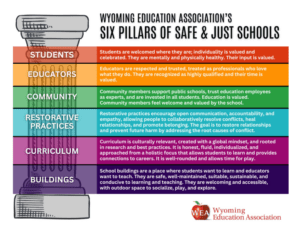
The WEA serves as a conduit for the NEA’s left-wing values, conveying them straight from D.C. into the schools in your community. The WEA’s Safe & Just Schools initiative (about which more below), for example, is based on the NEA’s Just & Equitable Schools campaign. There’s little daylight between the two organizations, which explains why the WEA is such a reliable voice for progressivism.

How does the WEA influence education policy in Wyoming?

The WEA attacks lawmakers who break with its radical legislative agenda to stand with Wyoming families. Using spin and deception about voting records, the WEA floods mailboxes with misleading ads during campaign season.

One tool the WEA relies on to influence politics is its legislative scorecard, which it uses to reward obedient lawmakers and penalize conservatives who support families and traditional values. 

Additionally, the WEA, through its PAC, intervenes in elections, endorsing and funding favored candidates and blasting conservatives who refuse to go along with its agenda. 

What does the WEA stand for?

The WEA says its mission is to “promote the cause of public education and improve the quality of teaching and learning,” but this bland mantra obscures the organization’s relentless opposition to parental rights, conservative values, and educational excellence. A more accurate and honest mission statement would be the following: “The WEA promotes public school bureaucrats and fashionable left-wing causes at the expense of families and students.” 

Here’s a partial list of the WEA’s stances:

Click here to read more about the WEA’s lawsuit against the ESA program.

The WEA is out of touch with what Wyoming parents expect of their schools

Honor Wyoming recently conducted a statewide poll of parents on public education, asking them to grade their public school experience on important criteria like curriculum quality, communication, student career readiness, and whether their values are respected in the classroom. Parents noted the following areas in which the education system has fallen short:

The WEA has done nothing to reverse these detrimental trends—indeed, it has worked to exacerbate them. 

Click here to read more about our education survey. 

So much for the Equality State

Senators Bo Biteman, Tara Nethercott, Mike Geirau, Barry Crago, and Representative Mike Yin all think it’s fine and dandy that some constituent emails go directly to a lawmaker’s inbox – while others go into the same folder as spam, malicious malware and phishing emails from nefarious sources. Potentially alongside possible hackers and foreign adversaries. If you didn’t watch the Management Council committee meeting on YouTube on November 19, you wouldn’t believe lawmakers said all this out loud. 

How did we get here?

In early January, the Legislative Services Office admitted that constituent emails were being quarantined by the State’s email system, and thousands of emails were not going to their lawmaker’s inbox.  These emails were being treated the same as malicious malware and phishing emails from nefarious sources.  

Honor Wyoming brought this matter to the attention of the LSO in the following letter:

After several weeks, the LSO released certain constituent emails from quarantine, as noted in an email communication on January 17th, 2025.


Lawmakers in Cheyenne had a chance to fix this problem permanently and prevent this from happening to constituents in the future by passing HB338 during the 2025 legislative session.  The bill simply required that:

  1.  The LSO publish a list of all domain names and addresses that are being quarantined or prevented from delivering email to legislators in any way.
  2. Any person whose email communications to legislators that had been quarantined would be able to contact the LSO to request that their emails be removed from quarantine and delivered to legislators. 
  3. The LSO would remove requested domain names or addresses from quarantine unless the release from quarantine or allowed delivery posed an actual security threat to the information technology systems of the state of Wyoming.

But, in a blow to free speech and a degradation of trust in the Wyoming political system, the bill was killed on February 3rd, 2025, before it was even assigned to a legislative committee for public input.

A voter poll conducted from March 28 to May 9, 2025, with more than 1,500 respondents, revealed that over 99% of Wyomingites believe it’s a violation of the Wyoming and US Constitution when the State limits communications between voters and elected officials in this way.  

This summer, over 2,000 voters signed a petition asking lawmakers to take action and remedy the situation, safeguarding their ability to reach their lawmaker’s actual inbox to share their opinions on the issues that matter to them most.

The LSO Management Council, a group of 10 state lawmakers who oversee the Legislative Services Office, had the chance to again address the problem in a committee hearing on November 19th with a similarly worded draft bill.  What happened?  Senator Bo Biteman, Senator Barry Crago, Senator Mike Gierau, Senator Tara Nethercott, and Representative Mike Yin voted it down.

During the hearing, these lawmakers testified that the claim of constituent emails being quarantined and blocked from their lawmaker inboxes was false.  They argued that the words “quarantine” and “blocking” are inflammatory and being used by Honor Wyoming to create strife and confusion.  But when Honor Wyoming presented emails from the Director of the LSO confirming that messages were being quarantined and kept out of lawmakers’ inboxes—meaning they were, in fact, being blocked—those same lawmakers shifted straight into damage control, attacking Honor Wyoming and playing word games.

Honor Wyoming was accused of being misleading for using the LSO’s own term “quarantine” and for stating the obvious — that stopping a constituent’s email from reaching a lawmaker’s inbox is “blocking communication between constituents and lawmakers.” The word games were a real head-scratcher when you consider the legal definition of “blocking” is “the action or fact of obstructing someone or something,” and they argued that they were not blocking emails but merely obstructing an email from reaching an inbox.

Senators Bo Biteman, Barry Crago, Mike Gierau, Tara Nethercott, and Representative Mike Yin suggested this was all a conspiracy created by Honor Wyoming, insisting the emails weren’t being quarantined but were simply going to spam. In other words, treating legitimate messages from Wyoming voters the same as spam, malware, phishing attempts, hackers, and foreign adversaries and kept out of a lawmaker’s inbox. In plain English, that’s misdirection and obstruction. And this is clearly a form of blocking.

They argued that there should be no statutory protection to distinguish legitimate constituent communications from malicious ones. No big deal, they said. Their solution is to make every lawmaker dig through their spam folders and hunt for your email among potential malware and phishing attempts, creating opportunities for security risks for both lawmakers and the state’s email system. This dramatically increases the chance that a well-meaning lawmaker could accidentally open dangerous spyware or other malware that could damage the state’s IT network or their own devices.

So the fact remains that your emails may be blocked from getting to your lawmaker’s inbox.  And thanks to these lawmakers, you will have no way of knowing.  

Keep in mind the solution they rejected. The LSO would continue to have oversight and the ability to block any email from any lawmaker’s inbox if they feel it presents a valid threat.  They were only asked to create a process that allowed any constituent to check whether their email was being blocked from their lawmaker’s inbox and sent to a spam folder.  Or junk folder.  Or quarantine folder.  Or whatever they want to call the folder where they send spam, dangerous and malicious emails that could pose a serious threat to the State’s email system. And creating a simple process whereby folks could ask to get their email address in good standing.  

Allowing a class system for constituent emails sets a dangerous precedent for eroding free speech. For the last eight years, conservatives have watched their voices throttled and silenced by Big Tech. Now we have Wyoming lawmakers arguing that some voices deserve access to a lawmaker’s inbox while others do not. It is uncomfortably similar to the very censorship battles we’ve already lived through.

PRAY. SPEAK. ACT.

52,000 Christians Slaughtered and Counting

In Nigeria, where the population is split nearly evenly between Muslims and Christians, it has become an almost everyday occurrence for militants and nomadic herders to descend on Christian villages, cut down entire families with bullets and machetes, set churches ablaze, and kidnap women and children.  

Since 2009, at least 52,000 Christians have been slaughtered—with over 7,000 deaths in 2025 alone. Tens of thousands have been abducted. Millions have been driven from their ancestral homes, where they have farmed for generations, and into dangerous, dirty camps rife with sexual violence. It is estimated that nearly 20,000 churches have burned to the ground.

The world has been slow to recognize the accelerating genocide against Nigerian Christians over the last decade and a half, but the anguished cries and the burned, blood-soaked villages are becoming harder to ignore. 

The legacy media tend to ignore the plight of Christians in Nigeria. When outlets do begrudgingly report on the most shocking attacks, they misleadingly frame the conflict as being primarily over scarce resources like land—and even a result of climate change. An absurd 2024 United Nations report, for example, avoids using the word “Christian” and attributes the murders entirely to climate change and ethnic conflict. The kicker is a self-pitying quote from a man representing a group of nomadic herdsmen who have been implicated in much of the violence: “Climate change is a new challenge that we didn’t experience 20 or 30 years ago; it’s really impacting us.”

Legacy media outlets, government agencies, and NGOs, chock-full of secular, Ivy League-educated progressives, will bend over backward to avoid confronting the fact that religion is at the heart of the violence. They will say, for example, that violence affects many groups in Nigeria, not just Christians. While it is true that innocent Muslims have also been victims at the hands of Islamist terrorist organizations, it is just not the case that Christian groups are inflicting violence upon Muslims. And even when Muslim groups are not targeting Christians specifically for their faith, they are doing so to drive them out and claim their land. 

Nigerian Christians are most at threat from Islamic terrorist groups like Boko Haram, which came to global prominence in 2013 for kidnapping 276 predominantly Christian schoolgirls, and Fulani herders, many of whom have become radicalized. The Fulani, the first ethnic group to convert to Islam in Africa, are spread throughout the continent. In Nigeria, many are pastoralists who live a nomadic lifestyle raising cattle. The Fulani have been pushing south into historically Christian areas with increasing frequency and aggression in recent years to engage in banditry and confiscate land.

Rev. Fr. Remigius Ihyula, the director of the Catholic Diocese of Makurdi’s Justice, Peace and Development Foundation, said, “These Fulani militias are not just killing—they’re clearing land to claim it. And they’re being allowed to do it.” 

Recent attacks help illustrate the barbarity, but only begin to tell a horror story that has been unfolding over decades. On Sept. 19, Catholic priest Mathew Eya was executed after militants on motorcycles shot out his car’s tires—and then turned their guns on him. Eya is one of over 500 clergy killed for their faith since 2015. In 2025, the violence has continued to escalate. In early August, cattle rustlers targeted a series of Christian farming villages, reportedly in retaliation for the theft of cattle, killing nine. On July 15, Muslim militants killed 27 Christians in a moonlit raid, some of whom, including a three-year-old girl, were burned alive in their homes. On June 13, 40 armed jihadists executed more than 200 Christians in the predominantly Catholic village of Yelwata. 

According to the International Society for Civil Liberties and the Rule of Law, a Nigerian Catholic nonprofit, roughly 30 Christians are murdered in the country every day. Open Doors International, a nonprofit that tracks persecution against Christians, ranks Nigeria as the eighth most dangerous country in the world for Christians, and the one with the highest number of absolute deaths. To be a Christian in Nigeria is to live with a target on your back. 

How did it come to this—and why aren’t more people talking about it?

As is so often the case, to make sense of the present moment, it is necessary to understand the past. 

Before the British took control of what is now called Nigeria, the northern regions were part of the Sokoto Caliphate, one of history’s most powerful Islamic empires. At the turn of the 20th century, British colonial forces, which already controlled the southern regions, defeated the caliphate’s supreme ruler, and formally took control of Nigeria. Although the Sokoto Caliphate ceased to exist, the British allowed local emirs to continue ruling on its behalf. 

The emirs, in keeping with traditional Muslim precepts, continued to forbid Christian evangelism. Meanwhile, Christian missionaries flocked to the south and, over time, evangelized large swathes of the region.

Nigeria officially gained independence from Britain in 1960 and became a democracy in 1999 following decades of rule by military despots. Today, Nigeria is home to Africa’s second-largest Christian population, around 100 million, and the vast majority of them live in the south. The north, in contrast, remains heavily Muslim. In a dozen northern states, governments have explicitly instituted Sharia law, and militant groups have seen in the Sokoto Caliphate a blueprint for the country’s future. The country has no official state religion, but it is a member of the Organisation of Islamic Cooperation, which describes itself as “The Collective Voice of the Muslim World.”  

It is in central Nigeria, in a broad strip of the country running east to west called the Middle Belt, where the lines between the country’s Muslim- and Christian-dominated regions blur and merge, and the persecution of Christians is most acute. 

A longstanding complaint among Nigerian Christians is that the federal government has barely lifted a finger to combat the terrorism that afflicts so many in their communities. Officials in Nigeria’s federal government deny that Christians are being targeted for their religion, and they play down the number of deaths. But these denials are unsurprising when you consider that President Bola Tinubu and Vice President Kashim Shettima are both Muslims.

The government’s apparent passivity in the face of widespread massacres suggests callous indifference, at best, and complicity, at worst. 

What can be done?

In 2021, the Biden administration, for unknown reasons, removed Nigeria from its list of countries that routinely violate religious freedom, known as Countries of Particular Concern. The Trump administration has yet to restore Nigeria’s place on that list, where it rightfully belongs. The public must demand that the Trump administration take this step, at a minimum. 

Momentum does seem to be building. In September, Texas U.S. Sen. Ted Cruz (R) introduced the Nigeria Religious Freedom Accountability Act of 2025, which would, among other provisions, target with sanctions any Nigerian officials who encourage, promote, or assist in the murder of Christians. Even Bill Maher, a staunch atheist who has a history of antagonizing Christians, used his platform on HBO in late September to bring attention to the genocide. 

Prayer is the single most important action Christians in America and the rest of the world can take at this moment. But actions must follow prayer, and what Nigerian Christians need is for Americans and people around the world to demand an end to the genocide..

Call your representatives, post on social media, submit letters and op-eds to your local paper, talk to your friends, families, and neighbors.

Holocaust survivor Elie Weisel wrote: “For the dead and the living, we must bear witness.” Those words are affixed within the halls of the U.S. Holocaust Museum, reminding us that silence and inaction are complicity. For the sake of Nigeria’s Christians, may Wiesel’s call be ours. 

Wyoming’s media peddled pandemic myths—and never came clean about it

Wyoming’s news outlets helped push incomplete information and withheld the full picture about the Covid-19 virus, masks, vaccines, and other aspects of the pandemic, accelerating declining trust in journalism.  

They did this in two ways. First, they accepted as true and happily parroted much of what mainstream public health officials and scientists said about the pandemic. They rarely expressed skepticism of the dominant narrative. Second, they closed their pages—virtual or otherwise—to contrary perspectives, denying readers the chance to learn that countless scientists were skeptical of what was over zealously declared “The Science.” 

To this day, Wyoming news outlets, including Wyoming Public Media, Wyoming Public Radio, Cowboy State Daily, the Casper Star-Tribune, Oil City News, the Gillette News Record, and others, remain unwilling to acknowledge the role they played in promoting a false, one-sided narrative. 

In traditional journalism, when a publication prints something false, misleading, or materially inaccurate, the ethical response is to issue a retraction or at least ensuring a full and complete record and representation of all the data. A retraction is essentially an admission that the outlet got it wrong—it acknowledges the mistake, corrects and or completes the record, and apologizes to readers for spreading misinformation. Retractions are a vital safeguard of journalistic credibility, used whenever the public has been misled.

That safeguard was conspicuously absent in Wyoming’s media coverage of Covid-19. Despite publishing (and often doubling down on) claims that have since proven to be false or at least highly contested, these outlets have not offered retractions, meaningful corrections or ensured a complete discussion with all scientific evidence. By refusing to apply the same standards of accountability they would demand from others, they have left readers with a distorted historical record of the pandemic.

Let’s examine a few of the biggest myths Wyoming outlets helped sell to an arguably fear-mongered public. 

Myth #1: Masks work to decrease transmission

Masks became one of the most visible symptoms of corrupted public health guidance. Everyone, even young children, was told to mask up. Wyoming’s outlets dutifully worked to enforce the directive. 

In October 2020, Oil City News ran a story that treated mask effectiveness as settled fact: “Hospital officials have reiterated that masks are effective when used properly,” the article declared. Yet even then, there were already serious and well-documented reasons to question the evidence for widespread mask use.

Rather than presenting that debate, Oil City News simply leaned on vague references to “hospital officials,” giving its call for masking the veneer of authority while withholding crucial context from its readers.

Other Wyoming outlets reported the same, often selectively choosing quotes from medical experts to present a one-sided narrative. WyoFile wrote, “Masks are one of many tools that can help slow the spread of the virus. 

Cowboy State Daily wrote that Alexia Harrist, the state’s highest health officer in 2020, “urged caution moving forward, noting that wearing face coverings and continuing to social distance will likely be a part of everyone’s lives for the foreseeable future, at least until a vaccine or treatment for the virus is created.”

The argument for masking healthy individuals was always questionable. Early in the pandemic, public health organizations like the CDC and the World Health Organization (WHO) discouraged people from wearing masks. Scientific studies at the time did not support the conclusion that masks, especially cloth masks, could reduce the transmission of viruses. 

The best and most current studies now tell us what so many knew or long suspected: masks do little to nothing to prevent the transmission of COVID-19. 

Myth #2: COVID-19 emerged from the wild 

Everyone agrees COVID-19 infected its first victims in Wuhan, a city in central China, in late 2019. But what else was going on in Wuhan at the time? 

It turns out that Wuhan is home to the Wuhan Institute of Virology, a lab conducting U.S.-funded gain-of-function research—modifying viruses to make them more deadly—on bat coronaviruses. The Institute is located just seven miles from the market where COVID-19 first jumped to humans.  

Quite a coincidence—or is it? 

At the beginning of the pandemic, scientists and public health officials disagreed about the origins of COVID-19. Did it come from a lab? Or did it jump from infected animals? The evidence for either explanation was, at the time, insufficient to form a firm conclusion. 

Did Wyoming’s news outlets adopt a neutral stance and carefully guide readers through the competing theories, allowing them to form their own opinions? You know they did not.

In Fall 2021, WyoFile made it clear which theory they supported: “Conspiracy theorists have speculated that the virus originated in a Wuhan lab and was either accidentally or deliberately released into the public.” In using the disparaging phrase “conspiracy theorists,” WyoFile communicated to its readers that essentially only people in tin hats would believe the COVID-19 virus could have escaped from a nearby virus laboratory. 

By 2022, mounting evidence pointed to the likelihood that the virus originated in a nearby laboratory. Yet the Casper Star-Tribune republished an Associated Press story claiming: “Scientists conclude that the virus that causes COVID-19, SARS-CoV-2, likely spilled from animals into people two separate times.”

In reality, no such consensus among scientists existed.

Many scientists weighed the evidence and came to the opposite conclusion. The press routinely vilified and slandered them as conspiracy theorists and racists. We now know the evidence for the lab-leak hypothesis is nearly overwhelming

Myth #3: mRNA vaccines are safe and everyone should get one—repeatedly! 

When the COVID-19 mRNA vaccines were first rolled out, the Biden administration, public health agencies, and major media outlets launched a full-court press to convince the public to comply. President Biden even attempted an unprecedented mandate forcing businesses with more than 100 employees to enforce vaccination—a move the U.S. Supreme Court later struck down.

Wyoming’s media outlets eagerly echoed this narrative, repeating the claim—falsely or incomplete information—that the vaccines were unquestionably safe.

In early 2021the Gillette News Record published an article titled, “Q&A: Common COVID-19 vaccine questions answered,” admonishing readers to set aside their concerns and get vaccinated as quickly as possible. The article states that “technology has been around close to 10 years, with this being the first chance to use it quickly and effectively.” Around the same time, WyoFile reported a doctor saying, “The vaccine isn’t just something that was slapped together too quickly, as some have argued.” 

Thanks to a recent report by the Senate Permanent Subcommittee on Investigations, we know the vaccine was, indeed, slapped together, and that the Biden administration purposely suppressed evidence that it increased the risks of certain heart conditions (myocarditis and pericarditis). And yet, those who made the perfectly reasonable decision to refrain from taking an experimental medication developed on the fly were bullied, harassed, and terminated from their jobs.

Shortly after the vaccines became widely available, the Biden administration began to aggressively pressure people to receive booster shots. Cowboy State Daily published a story that might as well have been a paid advertisement for Pfizer and other pharmaceutical companies. “Wyoming Dept Of Health Says More People Should Get COVID Booster Shots,” reads the fearless headline. 

Trust the experts? 

In July 2020, at the height of the pandemic, Wyoming Public Media published an article attempting to explain why some Wyomingites resisted health protocols like mask-wearing. The piece, titled “Why We Don’t Trust Science,” quoted “science communication expert” Professor Kaatie Cooper, who claimed: “I think that a lot of the rejection of expert recommendations about things like mask-wearing and social distancing really comes down to fear and a resistance to uncertainty.”

Missing from Professor Cooper’s patronizing analysis was any acknowledgment that so-called experts might be wrong. We now know that much of what public health authorities and the media packaged as unquestionable truth during the pandemic was, in fact, false or far less than complete—and in some cases, deliberately misleading as failing to give complete information. 

The pandemic ushered in a dark chapter in American history, one marked by stay-at-home orders, mask mandates, vaccine requirements, and other heavy-handed policies. None of it would have been possible without the eager cooperation of outlets such as Wyoming Public Media, WyoFile, Cowboy State Daily, the Casper Star-Tribune, Oil City News, the Gillette News Record, and others.

Until these outlets come clean about their role in spreading pandemic myths, they do not deserve your trust—or your support.

This article represents the opinion of the sponsor and is based upon published research and findings expressing opposing views and facts not published in Wyoming media outlets on Covid and vaccinations. 

Which special interest group is using WY students as their political pawns?

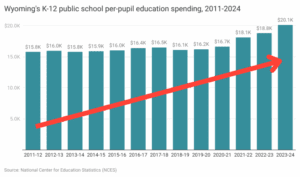
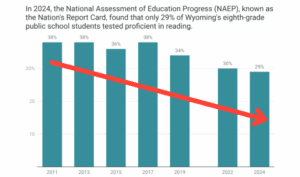
The Wyoming Education Association, the state affiliate of the DC lobbying organization National Education Association (NEA), is driving our education costs higher while test scores plummet. The education legislation and budgets they have successfully lobbied for in Cheyenne have been responsible for a 25% increase in per-pupil spending since 2011.  And test scores?  In 2024, the National Assessment of Education Progress revealed that Wyoming 8th graders’ proficiency in reading has plummeted by as much as 24% in the same timeframe.

Where is all this money going?  Not to teachers.

Consider this: between 2010 and 2024, teacher salaries have increased by a mere 5%.  You would think the Board of Directors of the WEA would be piping mad at the organization’s executives for such an abysmal track record.  

Not hardly.  According to tax records, the WEA’s Executive Director’s salary increased from $129,284 per year in 2011 to $175,528 per year by 2023.  An increase of over 35% versus teachers barely getting a 5% increase during the same period.  Obviously, WEA leadership is being rewarded for increased bureaucratic bloat over student excellence and teacher compensation.  

Wyoming classrooms are for Wyoming students and Wyoming teachers.  Not lobbyists with hidden agendas and ties to DC.  

It’s time we let the Wyoming Education Association know.  Hands off our classrooms!