This past legislative session, Wyoming Hospital Association (WHA) President Eric Boley marshaled his organization’s resources to sink a sensible bill that would have required hospitals to be up front about the prices they charge patients. Boley, who runs one of Wyoming’s most powerful lobbying groups, had a creative explanation for why Wyoming families pay exorbitant healthcare costs:
“The consumers aren’t working with their insurance companies,” he grumbled. “They’re not finding out what their payments are.”
In other words, you are the problem. It’s not that the Wyoming healthcare system is a tangled bureaucratic mess of overlapping providers, pharmacies, public and private insurance plans, and government agencies. It’s not that many Wyoming hospitals have been found to be out of compliance with federal price transparency requirements.
No, the problem is supposedly Wyoming citizens who fail to devote enough unpaid time and expertise to navigating a system so convoluted that even the institutions running it cannot fully explain how their own prices are set.
The WHA works hard to keep it that way. A ubiquitous presence in Cheyenne each legislative session,the WHA consistently aligns its advocacy with the policy priorities of the American Hospital Association (AHA), one of the nation’s most powerful healthcare lobbyists. This alignment has the effect of preserving high prices, limiting competition, and reducing price transparency for Wyoming families.
Here’s what you should know about these insidious organizations and their influence in Wyoming politics.
What is the AHA?
The American Hospital Association describes itself as “national organization that represents and serves all types of hospitals, health care networks, and their patients and communities.” It regularly spends millions each year to oppose federal legislation that it sees as threatening to hospitals’ bottom line. Founded in 1898, it has been a consistent force in American politics. Consistent, that is, at working for laws that enrich its members and make the healthcare system more confusing and less affordable for everyone else.
As the state affiliate of the ALA, the WLA closely follows the direction of the national organization. The ALA advances its priorities at the federal level, while state affiliates carry those same priorities into state and local policy debates. This structure allows the ALA to function as a centralized advocacy organization, with affiliates like the WLA promoting its goals within Wyoming.
The AHA says it serves “all types of hospitals, health care networks, and their patients and communities,” but its advocacy has resulted in few wins for patients. To understand the WHA’s approach in Wyoming, it helps to examine the national policy priorities of its parent organization. The AHA was one of the driving forces behind Obamacare. This objective was self-serving, as described by National Review’s Kevin Glass: “What the AHA wanted most was to preserve the flow of government money to its member hospitals, especially through Medicare and Medicaid. In exchange, the AHA agreed to the $155 billion in payment cuts, spent incredible sums of money on lobbying, and steered most of its campaign donations toward Democrats.”
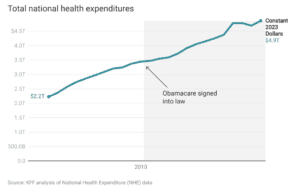
And how has that worked out? Since 2010, when President Barack Obama (D) signed Obamacare into law, total U.S. healthcare spending has increased roughly 40%.
This year, in line with its previous support for Democratic Party healthcare priorities, the AHA opposed President Donald Trump’s One Big Beautiful Bill Act (OBBB). The AHA cunningly framed its opposition as a concern for patients it claimed would lose insurance coverage due to the legislation, but reading between the lines shows its real worry was that hospitals would receive less government funding.
As a lobbying organization that represents large, often profitable hospitals, the AHA’s support for Democrat healthcare policies is unsurprising. Those policies tend to emphasize expanded public spending through programs like Medicare and Medicaid, which reimburse hospitals for services provided. Increased funding reliably benefits hospital systems financially.
What this approach does not necessarily emphasize is whether higher spending has led to better outcomes for patients. Despite rising healthcare costs, many Americans continue to experience longer wait times, higher out-of-pocket expenses, provider shortages, and uneven quality of care. The incentive structure rewards hospitals for volume and reimbursement, not for improving results. In that context, the AHA’s focus appears less centered on system performance and more on protecting the financial interests of its members.
The AHA and the WHA work together to quash competition
Capitalism benefits consumers by lowering prices and increasing quality, and it does this through market competition. If businesses have to compete against each other, they’re more likely to make choices with consumers in mind. The alternative, of course, is to go out of business.
The AHA opposes competition. Instead, the AHA lobbies for laws that protect its members from the competitive pressures that most other businesses face.
It has been highly successful at that goal.
Over the last few decades, the hospital sector has become more consolidated and less competitive, leading predictably to higher prices and lower quality of care. Multiple studies suggest that as hospitals merge, becoming larger but more impersonal, patient mortality actually increases!
Who is behind the decline in competition between hospitals? You guessed it—the AHA. In 2010, for example, the AHA successfully lobbied Congress to include in Obamacare a provision effectively banning the creation of new physician-owned hospitals. Before 2010, the number of physician-owned hospitals had been increasing to meet our aging country’s growing demand for healthcare services. Established hospitals, rather than compete with these smaller and more community-oriented providers, demanded to the tune of millions of dollars that the government protect them from competition—and lawmakers obeyed. The AHA now spends millions of dollars each year to keep the ban in place.
Another way the AHA protects its members from competition is through Certificate of need (CON) laws, which require state officials—such as a health planning agency—to approve new healthcare facilities or expansions. The AHA began lobbying for states to adopt CON laws in the 1960s and 1970s. At best, CON laws are unnecessary—competition, not bureaucrats, should decide if a given market can support a new or expanded hospital. At their worst, CON laws encourage the largest and most powerful hospitals in the state to curry favor with the bureaucrats charged with authorizing new certificates. Unsurprisingly, the big players, those with the most money, tend to have their way, commonly resulting in the denial of certifications.
At the start of 2025, Wyoming was one of 36 states with a CON law. In Wyoming’s case, the CON law applied to nursing homes. Some lawmakers have tried to repeal the law in 2024but the WHA has, like a fox guarding the henhouse, nipped those efforts in the bud. It was not until 2025 that lawmakers successfully passed HB 289, allowing for proper competition in nursing homes.
Less transparency, fewer beds, higher profits
Although the federal government has required hospitals to post their prices (prompting the AHA to unsuccessfully sue), most have dragged their feet or made only half-hearted attempts to comply.
More states are moving to pass their own price transparency laws, including Wyoming. Unfortunately, those efforts have not always been successful due to lobbying by groups like the AHA and WHA.
Wyoming’s HB 121, sponsored in 2025, would have required hospitals to maintain and make public a list of standard charges for items and services. HB 121 passed the House but failed narrowly in the Senate. Another unfortunate victory for WHA’s lobbying.
Wyoming families pay some of the highest healthcare costs in the region. Boley could use the AHA’s considerable resources to pressure hospitals into being more transparent about the prices they charge insurance companies and individuals, but he’d rather blame patients.
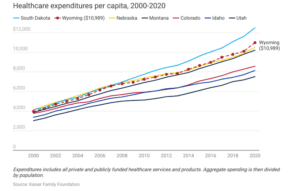
Incredibly, the number of hospital beds in Wyoming has decreased over time as the state’s population has grown, from 3.8 beds per 1,000 people in 1999 to 3.25 in 2023. In aggregate, Wyomingites are not only spending an increasing portion of their income on healthcare—they’re getting less in return over time. This should be a five-alarm fire, a turning point moment for organizations like the WHA that purport to take the Hippocratic Oath.
And what do we hear from the WHA about all of this? Crickets.
Wyoming or D.C.?
In its 2023 legislative recap, the WHA wrote: “Too often during the session we heard a narrative characterizing hospital [sic] as ‘big business’ or money hungry or as an arm of the federal government. This sentiment is a real challenge, which cannot be ignored and requires a concerted response.”
In other words, the WHA admits it has a PR problem. And why is that? If you’ve made it this far, you know it’s because the WHA’s lobbying history and its close relationship to the AHA paint a clear picture of an organization working in lockstep with outside interests to protect hospitals at the expense of Wyoming families. It’s that simple.
Like the Wyoming chapter of the American Academy of Pediatrics (AAP) and the Wyoming Medical Society (WMS), the WHA’s allegiance is to D.C. and the large corporations who fund these organizations. Not the people of Wyoming, and certainly not to our state’s conservative values. When well-heeled outside interests use the levers of government to benefit the few at the expense of the many, it’s obvious the system isn’t working as it should.
That’s where we come in. Join us as we build a movement dedicated to restoring integrity and transparency in Wyoming politics—starting with exposing the interlopers pushing D.C.’s soulless values on us.