Senators Bo Biteman, Tara Nethercott, Mike Geirau, Barry Crago, and Representative Mike Yin all think it’s fine and dandy that some constituent emails go directly to a lawmaker’s inbox – while others go into the same folder as spam, malicious malware and phishing emails from nefarious sources. Potentially alongside possible hackers and foreign adversaries. If you didn’t watch the Management Council committee meeting on YouTube on November 19, you wouldn’t believe lawmakers said all this out loud.
How did we get here?
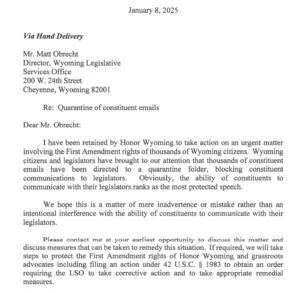
In early January, the Legislative Services Office admitted that constituent emails were being quarantined by the State’s email system, and thousands of emails were not going to their lawmaker’s inbox. These emails were being treated the same as malicious malware and phishing emails from nefarious sources.
Honor Wyoming brought this matter to the attention of the LSO in the following letter:
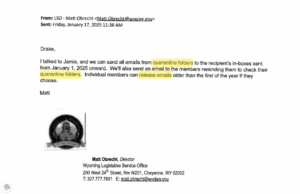
After several weeks, the LSO released certain constituent emails from quarantine, as noted in an email communication on January 17th, 2025.
Lawmakers in Cheyenne had a chance to fix this problem permanently and prevent this from happening to constituents in the future by passing HB338 during the 2025 legislative session. The bill simply required that:
- The LSO publish a list of all domain names and addresses that are being quarantined or prevented from delivering email to legislators in any way.
- Any person whose email communications to legislators that had been quarantined would be able to contact the LSO to request that their emails be removed from quarantine and delivered to legislators.
- The LSO would remove requested domain names or addresses from quarantine unless the release from quarantine or allowed delivery posed an actual security threat to the information technology systems of the state of Wyoming.
But, in a blow to free speech and a degradation of trust in the Wyoming political system, the bill was killed on February 3rd, 2025, before it was even assigned to a legislative committee for public input.
A voter poll conducted from March 28 to May 9, 2025, with more than 1,500 respondents, revealed that over 99% of Wyomingites believe it’s a violation of the Wyoming and US Constitution when the State limits communications between voters and elected officials in this way.
This summer, over 2,000 voters signed a petition asking lawmakers to take action and remedy the situation, safeguarding their ability to reach their lawmaker’s actual inbox to share their opinions on the issues that matter to them most.
The LSO Management Council, a group of 10 state lawmakers who oversee the Legislative Services Office, had the chance to again address the problem in a committee hearing on November 19th with a similarly worded draft bill. What happened? Senator Bo Biteman, Senator Barry Crago, Senator Mike Gierau, Senator Tara Nethercott, and Representative Mike Yin voted it down.
During the hearing, these lawmakers testified that the claim of constituent emails being quarantined and blocked from their lawmaker inboxes was false. They argued that the words “quarantine” and “blocking” are inflammatory and being used by Honor Wyoming to create strife and confusion. But when Honor Wyoming presented emails from the Director of the LSO confirming that messages were being quarantined and kept out of lawmakers’ inboxes—meaning they were, in fact, being blocked—those same lawmakers shifted straight into damage control, attacking Honor Wyoming and playing word games.
Honor Wyoming was accused of being misleading for using the LSO’s own term “quarantine” and for stating the obvious — that stopping a constituent’s email from reaching a lawmaker’s inbox is “blocking communication between constituents and lawmakers.” The word games were a real head-scratcher when you consider the legal definition of “blocking” is “the action or fact of obstructing someone or something,” and they argued that they were not blocking emails but merely obstructing an email from reaching an inbox.
Senators Bo Biteman, Barry Crago, Mike Gierau, Tara Nethercott, and Representative Mike Yin suggested this was all a conspiracy created by Honor Wyoming, insisting the emails weren’t being quarantined but were simply going to spam. In other words, treating legitimate messages from Wyoming voters the same as spam, malware, phishing attempts, hackers, and foreign adversaries and kept out of a lawmaker’s inbox. In plain English, that’s misdirection and obstruction. And this is clearly a form of blocking.
They argued that there should be no statutory protection to distinguish legitimate constituent communications from malicious ones. No big deal, they said. Their solution is to make every lawmaker dig through their spam folders and hunt for your email among potential malware and phishing attempts, creating opportunities for security risks for both lawmakers and the state’s email system. This dramatically increases the chance that a well-meaning lawmaker could accidentally open dangerous spyware or other malware that could damage the state’s IT network or their own devices.
So the fact remains that your emails may be blocked from getting to your lawmaker’s inbox. And thanks to these lawmakers, you will have no way of knowing.
Keep in mind the solution they rejected. The LSO would continue to have oversight and the ability to block any email from any lawmaker’s inbox if they feel it presents a valid threat. They were only asked to create a process that allowed any constituent to check whether their email was being blocked from their lawmaker’s inbox and sent to a spam folder. Or junk folder. Or quarantine folder. Or whatever they want to call the folder where they send spam, dangerous and malicious emails that could pose a serious threat to the State’s email system. And creating a simple process whereby folks could ask to get their email address in good standing.
Allowing a class system for constituent emails sets a dangerous precedent for eroding free speech. For the last eight years, conservatives have watched their voices throttled and silenced by Big Tech. Now we have Wyoming lawmakers arguing that some voices deserve access to a lawmaker’s inbox while others do not. It is uncomfortably similar to the very censorship battles we’ve already lived through.