Hospital Pricing Transparency? Wyoming Lawmakers Said No.

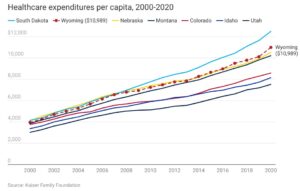
Here in Wyoming, we have the unenviable distinction of facing some of the highest healthcare costs in the region. According to data from the Kaiser Family Foundation, Wyoming residents’ per capita healthcare expenditures in 2020 were roughly 50% higher than in neighboring Utah.    

Recent legislation that would have helped Wyoming residents save money on their healthcare bills and put downward pressure on prices died in the Wyoming State Senate. The culprits? Fifteen Republicans (and one Democrat), who sided against Wyoming residents.   Instead, they chose some of the largest healthcare providers in the state.

HB 121, the “Hospital Price Transparency Act,” would have required hospitals to maintain and make public a list of standard charges for items and services—something most businesses already do. The legislation also would have prohibited hospitals that didn’t post their prices from sending unpaid bills to collections and authorized the Wyoming Department of Health to suspend, revoke, or deny noncompliant hospitals’ operating licenses.  

The House passed the bill 58-3, but it failed narrowly in a 16-14 vote in the Senate. Republican State Rep. Daniel Singh sponsored HB 121, saying, “If you go to the grocery store, you’re not going to check out eggs and not know directly how much you’re paying for the eggs, right? There may be variance in prices, right? But everyone has to be upfront about how much the eggs cost.”
 

For most of us, this is common sense. Who could disagree that we benefit when we know the prices we pay for goods and services?

If you want to know why someone might oppose legislation like HB 121, just look at who stands to lose if the status quo changes. 

Tellingly, the Wyoming Hospital Association (WHA) opposed the measure—and rallied its representatives to sink it. WHA President Eric Boley had the gall to blame Wyoming residents, saying “consumers aren’t working with their insurance companies. They’re not finding out what their payments are.” This is classic blame-shifting. Why should consumers have to go through a third-party to find out the price of basic medical services? That’s not how commerce works in most other areas of modern life. Boley also suggested a state-level law was unnecessary, saying, “I find it interesting that we want to pass additional laws when we already have federal laws in place.”

Although a federal law does require that hospitals post their prices, a 2024 Patients Rights Advocate (PRA) study of 2,000 hospitals found that 66% were out of compliance—an increase from the previous year’s report. Of the four Wyoming hospitals whose websites PRA studied in 2024, 75% were out of compliance. Indeed, hospitals across the country have dragged their feet in response to federal price transparency mandates. One hospital chain in Texas, for example, outright refused to comply in 2021, shortly after new requirements went into effect, saying a list of prices would only benefit its competitors (the chain eventually acquiesced).

State laws like HB 121 are necessary because broad federal mandates alone haven’t been sufficient to motivate compliance. Additionally, HB 121 was tailored to Wyoming’s healthcare system. The genius of federalism is that the people closest to the problem are often in the best position to know how to do something about it. 

Contrary to the WHA, whose members benefit from the present state of affairs, there are compelling reasons for Wyoming families to support laws like HB 121. 

For starters, the healthcare system has become such a thick tangle of state and federal regulations that few consumers ever know the actual costs their insurance covers. That makes it hard for consumers to know if they’re getting the best value for their money. Austrian economist F.A. Hayek won the 1974 Nobel Prize in Economic Science for his insight into the crucial role prices play in coordinating economic activity. New York University law professor Richard Epstein writes, “Hayek’s basic insight is that prices and markets facilitate selective communications among individuals and thus overcome the fundamental barrier of ignorance, one transaction at a time.” 

When it comes to the healthcare market today, the absence of transparent pricing perpetuates consumer ignorance, preventing individuals and families in Wyoming from comparison shopping and holding hospitals accountable for shady practices like overbilling.

Another benefit of price transparency is that it promotes competition among healthcare providers, helping to bring prices down. Currently, hospitals and other providers lack a strong incentive to compete for patients on price. Hospitals often get away with charging insurance companies wildly different prices for the same services, and patients are none the wiser. A 2021 New York Times investigation found that a hospital in Florida charged anywhere from $262 to $2,455 for the same M.R.I., while a hospital in Pennsylvania billed between $10 and $93 for a pregnancy test, depending on insurance plans. It is no surprise, then, that healthcare costs in Wyoming continue to go up, up, up.

Although the number of academic studies on hospital price transparency laws is limited so far, the evidence we do have suggests they work to reduce prices. A 2023 economic analysis estimated the country could save up to $80 billion by 2025 if providers fully complied with all federal transparency rules. The authors write that “across the American health care delivery system, incentives are misaligned, a significant bureaucratic paperwork exists, the true cost of care delivery is unknown, and prices from a patient point of view are shrouded in mystery”—and they hold up price transparency as an obvious policy for beginning to address those problems.

Other states, blue and red alike, are beginning to get the picture. In 2024, Oklahoma Gov. Kevin Stitt (R) signed legislation similar to HB 121 that requires providers to post prices for common procedures and blocks them from pursuing medical debt claims when they don’t. The bill received bipartisan support in both chambers of Oklahoma’s legislature. Minnesota enacted a law last year that sets standards for how hospitals publish their prices, making it easier for consumers to find and compare costs across providers.

It’s no surprise that the country is seeing a bipartisan push for transparency in healthcare costs. A 2023 poll found that 85% of Americans, including an equal number of Republicans and Democrats, support legislation that strengthens price transparency, so consumers can shop around. 

President Donald Trump (R) knows what Wyoming state Sens. Eric Barlow (R), Barry Crago (R), and others apparently don’t—that price transparency is good for consumers. That’s why Trump recently signed “Making America Healthy Again by Empowering Patients with Clear, Accurate, and Actionable Healthcare Pricing Information,” an executive order directing the Secretary of Health and Human Services to enforce price transparency laws in hospitals and healthcare plans. 

Trump’s executive order is welcome, of course, but as previous experiences with federal hospital price transparency efforts show us, states will need to lead the charge if we want to see real, sustained savings on our healthcare bills. HB 121 was an opportunity for Wyoming lawmakers to side with ordinary residents and shed light on an opaque pricing system. Regrettably, 16 senators voted against the public interest to keep Wyoming families in the dark. 

But Wyoming families deserve better. If our representatives won’t stand up to special interests, then it’s up to us to stand up to them at the ballot box, in public forums, and in every conversation about our healthcare system. When lawmakers choose powerful lobbies over the people they represent, they forfeit our trust—and we should remember it.
New Wyoming Law Blocks Ranked Choice Voting—Here’s Why It Matters

Wyoming lawmakers successfully passed HB165 – Ranked Choice Voting-Prohibition during the 2025 legislative session. The bill reaffirms Wyoming’s commitment to clear, transparent, and fair elections.

At its core, HB165 ensures that every Wyomingite retains the right to vote for one candidate who best represents their values, without interference or confusion caused by Ranked Choice Voting (RCV) systems. This law makes it clear that no election in Wyoming may be conducted using Ranked Choice Voting, and that any attempt by counties, municipalities, or other governmental bodies to implement RCV is invalid and void under state law.

But what is Ranked Choice Voting, and why has it become a controversial issue across the country?

What is Ranked Choice Voting?

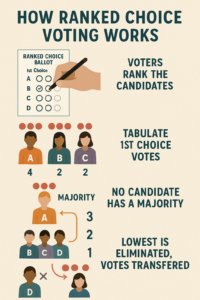
Ranked Choice Voting is a method of casting and counting votes where voters rank candidates in order of preference (first, second, third, etc.). If no candidate receives a majority of first-choice votes, the candidate with the fewest votes is eliminated, and their votes are redistributed to voters’ next choices. This process continues through multiple rounds until a winner emerges.

RCV is currently used in some cities and states, mostly in progressive-leaning areas. However, it’s been rejected or banned in over a dozen conservative states, including Idaho, Florida, Tennessee, Kentucky, Oklahoma, Mississippi, Alabama, Louisiana, Missouri, South Dakota, Montana, and Arizona—many of which cite transparency, fairness, and voter trust as key reasons for opposing it. After successfully banning RCV in Alabama, Secretary of State Wes Allen said, “Elections conducted using ranked choice voting violate the fundamental principle of ‘one-person one-vote.” He further explained this system is known to cause voter confusion, large percentages of spoiled ballots, and excessively delayed election results.”

ranked choice voting wyoming

Why Wyoming Said “No” to Ranked Choice Voting

While RCV is often promoted as a “modern” or “innovative” alternative to traditional voting systems, real-world experiences in cities and states where it has been implemented tell a different story. Far from improving the democratic process, RCV has introduced a host of problems that impact voters, complicate elections, and undermine trust in the outcomes.

Here are just a few of the most pressing concerns:

It Undermines the Principle of “One Person, One Vote”

In a traditional election, every voter casts a single vote, and the candidate with the most votes wins. It’s simple, fair, and straightforward. But Ranked Choice Voting changes that.

In RCV, some voters end up having their votes counted in multiple rounds, while others may only have their vote counted once. This happens because, as candidates are eliminated in successive rounds, the votes of those who ranked additional candidates continue to be redistributed, while the votes of those who didn’t rank remaining candidates are essentially ignored. This violates the long-held American principle that each person gets one equal vote—and only one.

It Leads to “Exhausted” Ballots

A significant issue with RCV is the concept of “exhausted” ballots—votes that don’t count in the final round of tallying. This can happen for several reasons:

In any of these scenarios, the ballot becomes “exhausted” and is not included in the final result. That means some voices are simply silenced before a winner is declared. In one San Francisco election, RCV led to nearly 10,000 ballots being discarded over 20 rounds of counting. That’s not voter empowerment—that’s voter elimination.

It Creates Confusion for Voters

The RCV system is complex, even for politically active and informed citizens. It asks voters not just to pick the candidate they support, but to rank multiple candidates in order of preference— even those they know little or nothing about.

This complexity results in a much higher rate of voter error. People may accidentally skip rankings, assign the same rank to multiple candidates, or misunderstand how the process works. A Rasmussen poll in 2023 found that only 32% of voters believe RCV is a more fair system than traditional voting—suggesting widespread confusion and skepticism. Studies also show that this confusion is even more pronounced among senior citizens, non-native English speakers, and first-time voters—the very groups we should be working to empower and include.

It Delays Election Results

In most traditional elections, results are known on election night, or within a day. With RCV, results are often delayed for several days or even weeks as officials go through multiple rounds of tabulation, redistributing and recounting votes in each round.

In a 2022 special election held in Alaska, it took over 2 weeks for a winner to be declared. This delay was due to the time required to count absentee ballots and conduct multiple rounds of tabulation inherent in the RCV process

This delay undermines voter confidence in the process and increases the risk of disputes, misreporting, and public mistrust, particularly in close or contentious races. At a time when Americans are already concerned about election integrity, introducing a system that drags out results and complicates verification is a step in the wrong direction.

It Creates Overwhelming Ballots

One of the lesser-discussed consequences of RCV is the sheer volume of information voters must process. With RCV encouraging larger fields of candidates, voters may be asked to rank a dozen or more individuals for a single office.

This means a responsible voter would need to research each candidate’s background, platform, and qualifications just to cast an informed ballot. That level of homework might be manageable in one race, but not across a full ballot with multiple offices up for election. Many voters end up guessing or skipping rankings entirely, increasing the number of exhausted or incorrectly completed ballots.

The Bigger Picture

Ranked Choice Voting may be gaining traction in progressive states, but the push to implement it nationwide is heavily funded—over $150 million was spent between 2022 and 2024 alone to promote the system. While it’s often packaged as “progress,” in practice, RCV introduces confusion, uncertainty, and unequal representation into our elections. That’s why conservative states across the country—including Wyoming—are choosing to reject it. With the passage of HB165, Wyoming has taken a firm stand for clear, constitutional, and trustworthy elections, keeping our voting process simple, secure, and exactly what voters expect and deserve.


Your Tax Bill May Still Spike—Even After Wyoming’s ‘Relief’ Measures

Now that Wyoming has implemented some minor property tax relief for residents, are our property tax issues truly resolved? 

The short answer is no.

While these measures provide some relief, they are not a sustainable solution. The real problem lies in the structure of Wyoming’s property tax system itself. Unless we address fundamental flaws through comprehensive property tax reform, these temporary fixes will continue to shift and evolve, never truly resolving the underlying concerns impacting Wyoming families.

Let’s begin by examining the root of the problem: the current property tax system. Wyoming’s tax system relies on a “Fair Market Value” (FMV) approach, as defined by Wyoming Statute 39-11-101 (a)(vi). According to the statute, FMV represents “the amount in cash, or terms reasonably equivalent to cash, a well-informed buyer is justified in paying for a property and a well-informed seller is justified in accepting, assuming neither party to the transaction is acting under undue compulsion, and assuming the property has been offered in the open market for a reasonable time…”. In simpler terms, it’s what a willing buyer and seller agree to in an open market transaction, often based on comparable properties.

Currently, Wyoming uses a system known as Computer-Assisted Mass Appraisal (CAMA) to calculate FMV, which is recalculated every year. The system uses broad market data provided by a vendor, data input by your local assessor, and applies automated formulas to determine property values. While the intention behind this system is to create consistency, it often fails to account for the unique characteristics of individual properties or specific circumstances surrounding property sales. Furthermore, the system incorporates a “replacement cost” component, which has skyrocketed since the COVID-19 pandemic, potentially fueling an unsustainable housing price bubble. With construction materials at record-high costs, most Wyoming families would be hard-pressed to afford replacing their homes at the prices dictated by this inflated “replacement cost.” This begs the question: Is “replacement cost” even a relevant factor in property tax assessments?

The second major flaw in this system is the annual recalculation of FMV. If a new neighbor moves into your community and purchases a home for $100,000 above market value, this new data, a replacement cost factor, and a set of calculations in CAMA that few can explain or easily verify, impacts your new assessment. Your property tax may now be assessed based on this new, inflated price, even if you recently purchased your home at a much lower price. Many residents have experienced the shock of purchasing a home only to see their tax assessment increase dramatically within a matter of months due to a reassessment. The result? Homeowners are taxed on valuations they might never see—if they even decide to sell at all. This situation leaves Wyoming families paying taxes on “unrealized” capital gains, a situation that doesn’t seem particularly fair.

In considering property tax reform, a shift from the current FMV system to an ‘Acquisition Value’ approach would base assessments on the property’s purchase price and cap annual changes at a small percentage, up or down. Acquisition Value is a far more stable, predictable basis for tax assessment.

Under this system, the property tax would be directly tied to the actual value agreed upon by the buyer and seller at the time of purchase, providing a clearer and more reliable assessment. This removes the uncertainty that comes with market fluctuations each year and eliminates the possibility of unexpected tax increases caused by random shifts in the market.

Critics of Acquisition Value might argue that this caps the counties’ and cities’ ability to generate revenue. In actuality, it would allow a more predictable expense for the homeowner and a predictable income stream for the counties and cities.  In short, we all have to work to our budget.  

Another argument is that this holds property tax assessments in place, even if the property’s market value falls.  If we allow a minor percentage change cap, we can easily allow the change up or down, but–let’s face it—how many of us have actually seen a significant decrease in our property tax assessments in recent years? More often than not, property taxes only seem to rise, leaving homeowners with a sense of vulnerability and no real protection against these random spikes.

For these reasons, and many others, acquisition value is the fairest approach for property tax reform. It allows for a more predictable and transparent process for homeowners, offering them the certainty that when they purchase a property, the property taxes they pay will align with the value they agreed to at the time of purchase—without the specter of unexpected increases.

Ultimately, if we want to truly fix Wyoming’s property tax system and provide meaningful relief for families, we need to move beyond short-term fixes and pursue real, lasting reform. The time has come to move toward a system that offers fairness, transparency, and predictability, so Wyoming residents can feel confident that their property tax obligations are based on a value they understand, not on an arbitrary figure subject to annual whims.


Censored by the State: Wyoming House Kills Bill restoring Citizen Free Speech

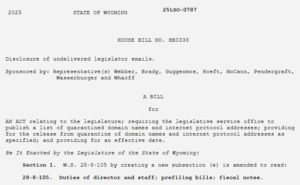
Wyoming citizens deserve unfiltered, direct communication with their elected officials. Yet, thousands of emails from constituents to their legislators have been blocked by the State’s email quarantine system—silencing voices and possibly violating constitutional rights.

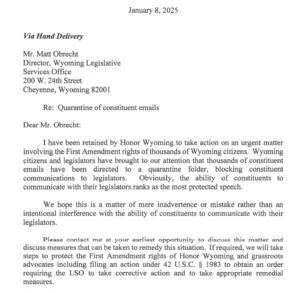
Honor Wyoming recently learned that these emails have been blocked through the State’s email quarantine system.  Whether wittingly or unwittingly, the Wyoming Legislative Services Office has been censoring communications with legislators. A potential violation of both the First Amendment of the United States Constitution and Section 20 of the Declaration or Rights in the Wyoming Constitution.  

Honor Wyoming sent the following letter to the Legislative Services Office as well as key lawmakers:

The situation raises significant questions about free speech and the ability of citizens to communicate with their elected representatives, which are core principles protected by both the U.S. Constitution and the Wyoming Constitution. 

Let’s break it down.

The First Amendment to the U.S. Constitution guarantees the right to free speech and the right to petition the government for a redress of grievances. Blocking emails from voters to legislators infringes on these rights, especially if it prevents citizens from expressing their views or seeking action from their representatives. Courts have consistently held that government actions restricting speech or access to officials must meet a high bar—typically a compelling state interest and narrow tailoring—to be constitutional. If the Wyoming state email system is “silently” quarantining thousands of voter emails without clear justification, notification, or an appeals process, it could be argued that this constitutes an unreasonable barrier to these First Amendment rights.

The Wyoming Constitution, in Article 1, Section 20, also protects free speech, stating: “Every person may freely speak, write and publish on all subjects, being responsible for the abuse of that right.” Additionally, Article 1, Section 21 guarantees the right to petition: “The right of petition … shall never be denied.” If the state’s email quarantine system is systematically preventing communications from reaching legislators without voters’ knowledge, it would be violating these provisions by effectively denying citizens their ability to speak to and petition their elected officials.

The highest order of protected speech is political speech between citizens and their lawmakers.  And a bill was filed in January to correct this problem by ensuring ALL emails reach lawmakers, stopping government censorship in its tracks. HB338 would have ensured transparency and accountability by requiring daily updates on blocked emails and a process for removing wrongful quarantines.

And yet in a dangerous blow to free speech, the Wyoming House of Representatives, under the leadership of Speaker Chip Neiman and Majority Leader Scott Heiner, refused to hear the bill during the 2025 legislative session.  

HB338 simply required that not less than one (1) time per day on each legislative day during a legislative session, the legislative service office had to publish or update a list of all internet domain names and internet protocol addresses that are being quarantined or prevented from delivering email to legislators in any way. 

Any person whose email communications to legislators that had been quarantined by the Legislative Services Office would have been able to contact the Legislative Service Office to request that their current and future emails be removed from quarantine and delivered to legislators. The Legislative Service Office would then have to remove requested domain names or internet protocol addresses from quarantine and allow delivery from the name or address within two (2) days of receipt of the request unless the release from quarantine or allowed delivery poses an actual security threat to the information technology systems of the state of Wyoming.

The fact that House leadership refused to take action on HB338 creates the appearance that this is more than a technical glitch; there might be a systemic restriction on constitutional rights.

Public trust in government agencies and politicians is at an all-time low.  Conservative grassroots America has been censored, shadow-banned and silenced to the point that there is zero patience or appetite for any more missteps when it comes to their First Amendment rights.  Especially here in Wyoming.  

It is paramount that our lawmakers work together to assure Wyoming voters that the days of government agencies engaging in the censorship business are behind us.  We need political leadership that proactively takes a stand for Protecting Free Speech between Citizens and their Lawmakers.

Teton County Illegal Immigrant Sanctuary Status

Since February 2023, ICE’s Enforcement and Removal Operations (ERO) has issued 118 detainer requests to Teton County Sheriff Matt Carr’s Office, asking the local agency to hold illegal immigrants in the jail for up to 48 hours until ICE could take over custody.  According to an ICE statement, 103 of those detainers fell apart after Teton County Sheriff’s Office let the suspects go before ICE could get them.

“Additionally,” the statement continues, “Teton County Sheriff’s Office does not notify (ICE’s operation) before releasing noncitizens from their custody, limiting (our) ability to take timely action on these cases.”

Teton County Sheriff’s Office is responsible for allowing illegal immigrants to slip away before they can be dealt with by the proper authorities.

Wyoming’s U.S. Representative Hageman has recently brought light to the subject:

“Teton County does not honor lawfully issued ICE detainers. Teton County has released criminal illegal aliens despite the fact that ICE has requested them to be held pursuant to U.S. immigration law,” wrote Hageman. “It is my understanding that every other county in Wyoming honors ICE detainer requests; the very ones that Teton County refuses to acknowledge.  Why is it that it’s Teton County that is having this issue?” asked Hageman.

She said some of the illegal immigrants were arrested on suspicion of driving while intoxicated or sex crimes.

“The people in Teton County and the surrounding area should be terribly concerned that (authorities are) releasing illegal aliens into the community, that have criminal records or that have been arrested for things that would actually qualify for them to at least go through the process for deportation,” Hageman said.

ICE also reported in a statement that things haven’t worked smoothly between the two agencies since an official talk with Democrat Sheriff Matt Carr on Feb. 22, 2023.  The statement explained that Sheriff Carr informed ICE that the Sheriff’s Office would only detain noncitizens based on a court request accompanied by a judge’s signature and that the sheriff’s office was pulling out of its intergovernmental service contract with ICE’s operations team.

U.S. Immigration and Customs Enforcement currently lists Teton County as a non-cooperative sanctuary jurisdiction

Take Action Now! Wyomingites need to let Teton County officials know that this lawless behavior is not ok in our state. Fill out THIS FORM and send an email to let your voice be heard.


Left-Wing News Media Bias Growing in WY

Trust in the news media by the American people is at an all-time low, especially among those on the right side of the political spectrum. You would think that news outlets and their reporters would respond by rededicating themselves to journalistic integrity. Unfortunately, many instead choose to double down on left-wing bias.  Equally disappointing is that Wyoming news media outlets are not immune.

To illustrate this increasing bias, we deconstructed a recent Wyofile article written by Maya Shimizu Harris covering the “takeover” of the Legislature by Wyoming’s “far-right movement”. Harris is a freelance journalist whose articles about the recent elections have been filed as “featured top stories” rather than “opinion,” yet they are full of obvious biases.

In this article on September 21, Harris characterized the contest between Julie Jarvis and incumbent Jeanette Ward as that of a moderately conservative heroine fighting against a radical, aggressive, and dishonest far-right, book-banning villain.

Despite WyoFile claiming on its webpage the goal of reestablishing “the primacy of facts in Wyoming’s public discourse,” this article instead provides a perfect case study in news media bias. Harris uses positive and empathetic language to describe Jarvis while framing Ward in a controversial or even negative light.

How has this type of partisan bias come to infiltrate Wyoming news media organizations?  In Wyofile’s case, we can consider influences like sitting Democratic State Representative Liz Storer from Jackson. Representative Storer serves as the president of her family’s private foundation which happens to be a major financial supporter of Wyofile.  It seems reasonable to think such liberal funding sources help drive biased reporting.  As well as the fact that WyoFile is the Wyoming partner of a national DC-based nonprofit known as States Newsroom. According to Influence Watch, States Newsroom was initially founded to promote progressive ideas and is led by veterans of the left-wing policy world. 

It is fair and reasonable to ask if outlets such as WyoFile are truly interested in unbiased local news reporting or if they are laundering progressive ideas into red states like Wyoming.

In her article, Harris describes Jarvis as a reluctant, thoughtful candidate who is uncomfortable with the aggression in the political system. Jarvis is portrayed as a mother, a fourth-generation Wyomingite, and someone who values listening to the people she represents.

Harris frames Jarvis’ initial reluctance to run for office as a virtue, portraying it as evidence of her humility and integrity. Her political associations, such as with Americans for Prosperity, are shown in a positive, moderating light, and the imagery of the article is meant to make her appear wholesome and relatable.  Trying to frame her campaign as an organic grassroots affair but somehow failing to mention the multitude of special interest industry PACs that lined up behind her candidacy.  

Ward, on the other hand, seems to be treated differently. Harris repeatedly uses the phrase “far right” to describe Ward and her colleagues in the Wyoming Freedom Caucus, and even compares her to Marjorie Taylor Greene. Ward is described as a “lightning rod” due to her political experience in Illinois, and Harris frames her opposition to inappropriate materials in schools and libraries as opposition to transgender rights.

Jarvis’ victory is portrayed as a triumph of good over evil, like David slaying Goliath. Conversely, the fact that the Wyoming Freedom Caucus won enough seats to potentially control the next Legislature is presented as an ominous development, leaving the reader with a sense of impending doom.

There’s nothing wrong with authors crafting narratives from current events or telling stories from one perspective. There’s also nothing wrong with publishing opinions about political figures. However, there is an issue when narratives and opinions are labeled as “news.” The reality is that the people of Wyoming are far more conservative than the authors and editors of outlets like WyoFile, as voters of Wyoming just demonstrated by their strong support of Wyoming Freedom Caucus candidates and overwhelming opposition to longtime political power brokers. Yet, this article — and others on WyoFile — treat this grassroots majority as a fringe minority, a “far right” group of extremists out of step with the mainstream.  Trying to obscure the inconvenient election math that clearly establishes who actually is the mainstream.

Perhaps these news organizations should take a closer look at their own positions and ask whether they are measuring themselves by the people of Wyoming or by the ideas emanating from Washington, DC via States Newsroom and other large media conglomerates. The people of Wyoming deserve a news media that is fair, objective, and treats them with respect — not disdain.


Wyoming Becomes a Destination for Abortion Tourism: Is This the Future We Want?

Wyoming Becomes a Destination for Abortion Tourism: Is This the Future We Want?

A recent search on AbortionFinder.org reveals that at least three private foundations are currently offering financial assistance to women from other states to travel to Wyoming for abortion services. This development raises important questions about Wyoming’s legal stance 

Wyoming law permits abortions up to the point of viability, which can be as late as 26 weeks into a pregnancy. This legal framework places Wyoming among a small number of states where abortion access is relatively unrestricted, comparable to states like California and New York, which are known for their pro-abortion laws. As a result, Wyoming has become a destination for women from states with stricter abortion laws seeking access to the procedure.

After the U.S. Supreme Court overturned Roe v. Wade, returning the authority to regulate abortion to the states, Wyoming lawmakers acted swiftly. They passed HB 152, known as the Life is a Human Right Act, with overwhelming support (81%). This bill repealed existing viability laws and aimed to protect unborn children while leaving exceptions for cases of rape, incest, and when the life of the pregnant woman is at risk.

However, this legislation was quickly challenged in court. A lawsuit was filed by a group of pro-abortion advocates, including:

The lawsuit was strategically filed in the 9th District Court of Teton County, known for its more liberal leanings. Nearly a year and a half later, Judge Melissa Owens has yet to rule on the constitutionality of the Life is a Human Right Act. In the meantime, the law remains in legal limbo, and Wyoming has become a haven for abortion tourism.

As the debate over abortion continues to unfold in Wyoming, many are left asking: Is this the future we want for our state? The delay in the judicial process has created a situation where Wyoming is increasingly seen as a destination for abortion, raising concerns among pro-life advocates and lawmakers who want to see stronger protections for unborn children.

If you believe that Wyoming should prioritize the protection of unborn children and reexamine its abortion laws,  consider sharing this information with others in your community.

Is the Cowboy State Daily Showing Political Bias? Evidence Suggests Yes

Independent research has revealed that the Cowboy State Daily, one of Wyoming’s largest news outlets, may be providing biased political coverage, favoring politicians who receive donations from its owner, Wayne Hughes.

Wayne Hughes, a California businessman, relocated to Wyoming in 2017 and quickly became a major player in state politics. Records from the Wyoming State Campaign Finance database show that Hughes contributed more than $595,000 to various political campaigns during the 2020 and 2022 election cycles. Then, in February 2022, Hughes acquired the Cowboy State Daily, a prominent Wyoming publication. Since then, concerns about potential political bias in the newspaper’s reporting have emerged among Wyoming residents.

An independent analysis conducted on 562 articles published by the Cowboy State Daily after Hughes assumed ownership reveals a significant disparity in how the publication covers Wyoming lawmakers and political candidates. The study found that:

Media outlets like the Cowboy State Daily are not required to report positive coverage as a political contribution, nor are they obliged to disclose that their ownership has made financial donations to the figures they cover. This raises ethical questions about transparency in media, particularly when coverage can influence public perception.

Wyoming voters deserve transparent reporting from their media, especially when there may be a conflict of interest. A simple solution would be for the Cowboy State Daily to include disclaimers in articles that mention political figures who receive support from Wayne Hughes or his political action committee (PAC). This would give readers a clearer understanding of any potential bias in the coverage.

If you believe that Wyoming citizens deserve more transparency from one of their largest news outlets, consider sharing this information with others in your community. In an era where media influence can shape elections and policy, it’s crucial that voters are well-informed and aware of potential biases in the news they consume.

Wyoming families carrying burden of energy taxes and incentives

By the time you get your bill, it’s too late. Wyoming customers of Rocky Mountain Power are reeling after the company requested a 14.7% rate hike, following earlier increases this year of 5.5% and 9.3%. The company attributes the latest hike to wildfire risk and investments in renewable energy, offering little comfort to the thousands of customers watching their electric bills soar.

Governments at all levels are spending trillions of dollars to transition the country to so-called renewable energies like wind and solar. They justify this investment by citing statistics that claim these sources are cheaper than fossil fuels, but these numbers are often criticized as only applying when the wind is blowing or the sun is shining. To provide the consistent energy Wyoming residents need, coal remains essential.

The fact that Rocky Mountain Power customers are seeing higher rates as the company invests in renewable energy reveals the fallacy of thinking these technologies will lower costs. On the other hand, Wyoming exports more electricity than it consumes, raising the question: why are residents being subjected to rising rates?

Decisions about divesting from fossil fuels, how much electricity to export, and even how to manage wildfire risks are made by politicians and the bureaucrats who serve them. Yet, voters rarely consider their electric bills when casting ballots. Is the candidate you’re voting for in the Legislature likely to support policies that increase your bills? Will the governor’s political appointees choose to export more electricity while charging you to build additional wind and solar farms?

Last year, several bills aimed at increasing taxes on wind companies failed to pass the Wyoming Legislature. One bill sought to repeal a three-year tax exemption for the industry. Currently, wind companies are charged $1 per megawatt hour of generated electricity, but only starting in their fourth year of operation. Industry leaders argued that such measures would reduce investment in Wyoming’s wind sector, even though these companies already receive $27.50 in federal credits for every megawatt hour produced in their first ten years.

The energy industry operates under a Byzantine system of taxes and incentives, with governments at every level distorting the economic playing field. In the end, it’s the citizens who lose—paying for this social engineering both directly, through their electric bills, and indirectly, through taxes that subsidize these industries.

We need leaders at the state and national levels who will put citizens first — not green energy schemes that only seem to drive prices higher.