Parents across Wyoming Grade Their Children’s Public School Experience a C-

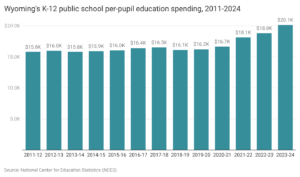
Honor Wyoming conducted a statewide parent poll on public education, asking families to grade their public school experience on important criteria like curriculum quality, parent communication, career readiness and whether their values are respected in the classroom.  Hundreds of families across Wyoming participated in our survey, providing us with valuable insights into what was driving this poor grade.  There is much to be said about the fact that K-12 education spending in Wyoming has increased by 27% between 2011 and 2024, while reading proficiency has declined by 24% during the same period.

However, parents have numerous other concerns about Wyoming’s public school system.
Here’s a look at the Top 4 Issues reported by Wyoming families, including their feedback about the root causes as well as potential solutions.


     1. Bloated, Unresponsive Administrative Class and Poor Leadership

Parents are viewing education through a different lens than they once did and are increasingly concerned about a bloated, unresponsive administrative class in Wyoming’s education system. School administrations are increasingly being seen as disconnected and ineffective. Administrative costs have ballooned and families have become aware of this fact as property taxes and school budgets continue to skyrocket while test scores and responsiveness to parents decline. Reaching out and getting a solution to their concerns has become next to impossible because parents are continually handed off to the next layer of an ever-growing bureaucracy. They complain of navigating through layers and layers of administration and not feeling heard.  It’s equally frustrating to see this bureaucratic bloat and apathy when they understand teachers are overworked and salaries have remained stagnant (only going up 5% in over a decade).  It’s no secret that administrative budgets divert resources from core educational functions, a view echoed in Wyoming’s push for transparency, as outlined in the recent Wyoming Department of Education’s 2024 Strategic Plan.  The correlation between increased administrative positions and unresponsiveness to parents’ needs could not be more obvious. 

Parents want leaders who listen and act decisively, not administrators who insulate themselves from accountability. The issue is significant because it erodes confidence in the ability of staff to serve students, families, and communities effectively.

The type of solutions parents suggested to address this issue included:

  1. Misallocated Resources and Overburdened Teachers 

Parents in Wyoming are frustrated that, despite the state spending approximately $26,000 per student in the 2024-25 school year (one of the highest rates in the nation according to the National Center for Education Statistics), teachers are not seeing proportional benefits in their classrooms to these increased budgets.  All the while, student proficiency in core subjects like math and reading continues to disappoint. The Wyoming Department of Education reported in 2024 that only 54% of students met proficiency standards in reading, down from 56% in 2019, despite a 22% increase in per-pupil spending since 2020. 

Parents point out that teachers are increasingly tasked with roles beyond education, such as acting as nurses and mental health counselors, which dilutes their focus on teaching. Teachers are also having to fulfill burdensome requirements to receive funding from grant programs, diminishing class instruction time. This misallocation of resources and responsibilities is driving teacher burnout, with a 2023 Wyoming Education Association survey noting that 65% of teachers considered leaving due to overwhelming non-instructional demands, not just salary concerns. 

This issue is of great importance to parents because education should prioritize student learning, and teachers are most effective when focused on their core purpose: imparting knowledge. When resources are diverted to non-educational roles or administrative overhead & non-essential expenditures, classrooms suffer and teachers are unfairly burdened.  Schools must refocus on academic fundamentals to improve outcomes, a view shared by parents who want teachers empowered to teach. 

The type of solutions parents suggested to address this issue included:

  1. Fatigue with Social Advocacy and Indoctrination

Parents across Wyoming expressed a collective exhaustion with what they perceive as social advocacy or indoctrination in schools, particularly around political or social issues like critical race theory or gender ideology, and now the new catch-all programs called Social Emotional Learning. Even though Social Emotional Learning is being touted as a mental health solution, upon examining actual surveys and courses to which their kids are being exposed, it appears to be another tool that could turn into pushing political and social agendas that have no place in our public schools.

This seems to be a shared sentiment that curricula are pushing ideological agendas over objective education, as seen in national debates where 17 states, including Tennessee, have restricted discussions on race and gender since 2021. This matters because parents believe schools should focus on equipping students with basic skills (reading, writing, math), not promoting divisive ideologies, which they fear undermines families and academic rigor. 

The concern is rooted in a desire for education to remain neutral, fostering independent thought rather than conformity, and a return to classical education, which emphasizes core subjects and universal values over activist curricula.

The type of solutions parents suggested to address this issue included:

  1. Ineffective Discipline Policies and Disruptive Behavior 

Parents are alarmed by lax discipline policies that fail to address disruptive students or bullies, creating unsafe and chaotic classrooms. The National Center for Education Statistics reported in 2024 that 19% of Wyoming students experienced bullying, with only 44% of incidents reported to adults, suggesting weak enforcement. Parents cite examples of unchecked classroom disruptions, with a 2023 NEA survey noting 68% of Wyoming teachers faced verbal abuse from students monthly. This matters because disruptive behavior hinders learning and safety, leaving parents feeling schools prioritize leniency and “passing on” a student over accountability, eroding trust in the system’s ability to protect their children. 

In this increasing culture of leniency, parents are starting to see failures that address escalating disruptions.  The leniencies in our current school districts are seen as major contributors to a climate where students are being bullied, children are learning there are no consequences for being a bully, and children are being handed an enormous hindrance by the education system because feelings are taking precedence over becoming a functioning member in society. They are frustrated that the feelings of a few have trumped the safety of the many. 

The issue is critical as it affects every student’s ability to learn. Parents argue that clear boundaries and consequences foster respect and order, but they feel that this is lacking more and more. Many parents feel there is a lack of authority in the classroom, coupled with administrative inaction.  A lack of commitment to order and accountability in the classroom is making it very hard to build a culture of responsibility and ensure classrooms are safe and conducive to learning.

The type of solutions parents suggested to address this issue included:

The 340B prescription drug program benefits Wyoming hospitals—but does it help patients?

Across the country, lawmakers from both sides of the political spectrum are demanding transparency in the federal 340 B drug rebate program.

The “B”, as it turns out, ought to stand for “boondoggle.” 

Congress enacted Section 340B of the Public Health Service Act in 1992 with the stated goal of providing inexpensive pharmaceuticals to hospitals and clinics that serve low-income and uninsured patients who are paying out of pocket. The program enables participating healthcare organizations to purchase drugs at a significant discount from drug manufacturers, theoretically allowing hospitals and clinics engaged in charity care—offering free or discounted services to low-income or vulnerable patients—to allocate more resources to assisting the needy. 

But Congress, in its infinite wisdom, placed few guardrails on the program. When 340B hospitals prescribe discounted drugs to patients, they can charge insurance plans—or uninsured patients paying out-of-pocket—as much as they want, and there’s no requirement that they use the profits or savings to expand care for the uninsured or otherwise disadvantaged. Some estimates suggest 340B hospitals charge, on average, nearly three times what they initially paid for the medications. 

Congress, which described the 340B program in 1992 as an effort to stretch “scarce Federal resources as far as possible, reaching more eligible patients and providing more comprehensive services,” did not even require that participating healthcare organizations disclose the amount they spend on charity care.

Hospitals have wasted no time taking advantage of 340B, which is now the second largest federal pharmaceutical program. Participation has exploded since the program’s inception, going from 90 hospitals in 1992 to over 2,600 today. 

It’s no mystery why hospitals are eager to sign up. The Berkeley Research Group estimates that hospitals earn an average profit margin of 72% on 340B drugs, compared to just 22% for drugs purchased outside the program. Berkeley estimated hospitals brought in over $13 billion in profits in 2018. Unfortunately, two-thirds of those hospitals are outside of medically underserved areas—the very places 340B was designed to help. 

It’s not only hospitals that benefit from the 340B program. 

Due to a change implemented under President Barack Obama (D), for-profit retail pharmacies make billions by fulfilling prescriptions through the 340B program. The original program required participating hospitals to use their own “in-house” pharmacies to fulfill prescriptions, a rule that limited who could benefit from 340B. Now, for-profit pharmacy chains can get a cut of the profit that hospitals earn from prescribing discounted drugs to patients. 

Unsurprisingly, the number of contract pharmacies has exploded since 2010, with over 32,000 locations (more than half of all pharmacies) now fulfilling prescriptions for the 340B program. More than three-quarters of those locations are owned by CVS, Walgreens, and Walmart, the largest pharmacy chains in the country. 

Republican and Democratic led states have begun stepping in to require transparency from organizations participating in 340B. MultiState, an organization that tracks legislation, identified 340B reform bills introduced in 15 states in 2025. One of those states was Idaho, which passed a law—HB 136—requiring 340B hospitals and clinics in the state to submit annual financial reports on drug expenditures and revenues to the Department of Health and Welfare. The reports must include data on how much of the money made off the 340B program goes to charity care, allowing Idaho residents and legislators to know if the program is actually serving needy populations. 

Idaho State Representative Jordan Redman (R), who sponsored the bill, said, “By requiring 340B-covered entities to report detailed financial data, this bill aligns with Idaho’s longstanding efforts to ensure that public funds and taxpayer-supported programs are used responsibly.” 

Wyoming’s hospitals participate in, and benefit from, the 340B program. But how much do residents benefit? 

According to PhRMA, a pharmaceutical trade group, Wyoming’s 15 participating 340B hospitals spend just 1.7% of their total expenses providing care to low-income or uninsured patients who are paying out of pocket—32% less than the national average. PhRMA notes that between 2014 and 2022, Wyoming hospitals actually decreased their spending on needy patients by 43%.  

Hospitals and their lobbying groups oppose greater transparency in the 340B program because it has allowed them to generate billions in profits while demanding little in return. There’s no evidence 340B hospitals are using profits from the discounted drugs to expand care for the populations the 340B program is supposed to help. Each time Congress, the Department of Health and Human Services (HHS), or the courts appear willing to take a hard look at the program, the American Hospital Association (AHA), which represents thousands of hospitals, sends a barrage of lobbyists to D.C. to snuff out those efforts.  

Politico reported in 2023 that AHA “has opposed proposals to ‘dramatically” expand reporting requirements and policies that would “scale back” or “significantly reduce the benefits” of the program.

Unlike in neighboring Idaho and Utah, Wyoming’s elected officials have dragged their feet on demanding accountability from the powerful hospitals given carte blanche to mark up drugs they buy at a discount. That may have something to do with the pervasive influence of the Wyoming Hospital Association, one of the most powerful lobbying groups in the state. The Wyoming Hospital Association PAC donated to 68 state lawmaker campaigns in the last two years, and its ties to AHA run deep. 

Wyoming lawmakers have the opportunity to bring transparency to and help reform a misbegotten federal program that has strayed far from its original purpose of helping the disadvantaged, pushes up healthcare costs for ordinary taxpayers, and disproportionately benefits the largest hospitals and pharmacy chains in the country. 

This isn’t a partisan issue: it is common sense. Wyoming families, who already shoulder some of the highest healthcare costs in the western United States, have a right to know if the state’s 340B hospitals are abusing the spirit of the program by jacking up drug prices and pocketing the profits. A simple bill requiring transparency from hospitals is just what the proverbial doctor ordered.   

Whether lawmakers actually fill that prescription and stand up to special interests remains to be seen.

The Wyoming Education Association sides against families, surprising no one 

On June 27, the Wyoming Education Association (WEA), a leftwing advocacy group that represents public school bureaucrats, persuaded a judge to temporarily block the state’s new Education Savings Account (ESA) program from taking effect on July 1. The WEA is a longtime advocate against giving families choice in education, regularly lobbying lawmakers in Cheyenne to keep kids in schools that aren’t working for them. Its latest lawsuit is as predictable as it is harmful to Wyoming students and their parents.  

The ESA program, created in 2024 and expanded this year to make all students eligible, provides participating families with up to $7,000 for approved educational expenses, such as tutoring services, homeschooling textbooks, private school tuition, and more. In short, the ESA program gives Wyoming students an escape hatch out of the public school system when it isn’t working for them. 

This was something the WEA couldn’t stand, so they sued to shut down the program, leaving nearly 4,000 families in a lurch as the 2025-26 school year looms in August. Judge Peter Froeliche’s block on the program will remain in effect while he decides the outcome of the case. 

The WEA claims to represent all stakeholders in the public school system. However, its lobbying efforts reflect the interests of two often overlapping groups—bureaucrats who benefit financially from keeping students in failing public schools and leftwing ideologues who believe governments, not parents, should primarily shape students’ moral upbringing. 

Who doesn’t the WEA represent? Families. 

The WEA is the state affiliate of the National Education Association (NEA), the country’s largest union. The NEA spends tens of millions of dollars each election cycle helping to elect Democratic candidates up and down the ballot who oppose school choice. During last year’s presidential election, the NEA endorsed Kamala Harris, who once said, “When you see our kids, and I truly believe that they are our children, they are the children of our country, of our communities.”

This chilling sentiment helps explain why the WEA is so opposed to policies that undermine the public school system’s near-monopoly on K-12 education. In the WEA’s twisted understanding of education, students exist to serve the public school system, not the other way around. 

The WEA claims in its lawsuit that the ESA program violates the Wyoming constitution because it “diverts public education funds to private entities with no meaningful oversight or accountability.” These are the same tired falsehoods the left has unsuccessfully advanced against school choice programs in other states. The accusations about oversight and accountability ring especially hollow to many Americans because public schools continue to receive an ever-increasing amount of funding, even as test scores decline or stagnate.Wyoming, for example, spends over $20,000 per public school pupil—higher than the national average of $17,144. Wyoming’s spending on education continues to increase each year, something the WEA always fails to point out.

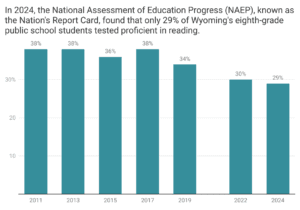
Meanwhile, the latest National Assessment of Education Progress (NAEP) report, known as the Nation’s Report Card, finds that only 29% of eighth graders in the state are considered “proficient” in reading—a percentage that continues to decline each year. To put that figure a different way, 71% would struggle to “identify basic literary elements such as order of events, character traits and motivation, and main idea” in a fictional book.

As public schools have spent more time instructing students on the finer points of DEI, Social-Emotional Learning (SEL), and other progressive orthodoxies, they’ve devoted less time to teaching reading, writing, arithmetic, and other foundational skills. It’s no wonder that public school enrollment is declining around the country.  

Let’s walk through a few of the WEA’s deceptions.

For starters, Wyoming’s ESA program takes no money—we repeat, no money—from the education budget. The 2024 and 2025 bills appropriated $50 million in funding only from the general fund, leaving the education budget untouched (roughly $1.5 billion!). The WEA conveniently leaves this fact out of their press releases. 

The claim that the program lacks accountability and oversight is similarly—and obviously—false. The program places commonsense restrictions on how families can use the ESA money, ensuring it is put toward legitimate educational expenses, and empowers the state superintendent of public instruction to investigate allegations of misused funds. This is information that anyone could find through 30 seconds of basic research into the program.   

Those accountability measures, however, play second fiddle to the program’s most important guardrail—parents themselves. Parents know their children’s educational needs better than WEA bureaucrats, school administrators, or lawmakers, and it is parents who decide where and how to use the funding. Private schools, for example, that fail to provide an excellent educational experience—academically or otherwise—will soon find themselves struggling to attract new students.

This, ultimately, explains why the WEA is so desperate to stop a program that costs less than 2% of the state’s K-12 education budget. In the absence of school choice, public school becomes the default for most families. Since most parents will struggle to afford educational alternatives to the public school system, they’re stuck with the public school to which they’ve been assigned, regardless of quality. This is great for the WEA bureaucrats and public school administrators, who depend on state funding for their paychecks and a continuous supply of impressionable students on which to push their political agendas. But it’s not so great for students or their families, especially when they lack the means to move to a better school district or find an alternative educational arrangement for their children.  

Wealthy families have always had a choice in how to educate their children. But poor and middle-class families are too often forced to send their kids to a public school that might not fit their unique needs.

For this reason, Wyoming’s ESA program aims an arrow at the heart of the public school monopoly, providing educational options to all students. Those options could include homeschooling, virtual academies, microschools, and so on. For many parents, the best option will still be the local public school, and the ESA program won’t change anything for them. But for thousands of families, the program will give their kids a lifeline, a real chance at thriving in the classroom.   

That includes families like Nicolette and Travis Leck, who reside in Cody, and who have joined the lawsuit in defense of the ESA program. The Leck’s three boys struggled in public school, so Nicolette and Travis enrolled them in a classical school where they have “benefitted from regular feedback, a more structured learning environment, and focused instruction in music and Latin.” Education is so important to the Lecks that Nicolette got a full-time job to help the family afford the classical school’s pricey tuition. The ESA program will go a long way toward helping the Lecks ensure a quality education for their boys. 

Isn’t that a win for not only the Lecks but also all of Wyoming? If the WEA cared at all about student outcomes, they’d cheer that the Leck boys found a school in which they thrive. Instead, the WEA is adamant about ending a program that will help so many kids, even though it doesn’t divert a single penny from the public education budget. 

The WEA’s priorities are clear—bureaucrats over families. 

With school beginning in August, Judge Froelicher’s decision to stop the program from dispersing funds means families are left scrambling to rethink their plans for the next year. We urge Judge Froelicher to issue a quick ruling that recognizes the program is consistent with the Wyoming Constitution. Wyoming’s public school system exists to provide a robust education to students. It is not an end in and of itself or a make-work program for bureaucrats, and its one-size-fits-all approach to schooling cannot meet the needs of every family. Families have a right under the U.S. and Wyoming constitutions to seek the best education for their children, and the ESA program helps facilitate that without diverting funding from the public school system.  

The WEA can only prevail at the expense of families. For the sake of Wyoming’s students, let’s hope they don’t succeed. 

Learn more about the WEA here:

2025 Integrity Index: Wyoming Lawmaker Results Are In

After each legislative session, Honor Wyoming releases the Wyoming Political Integrity Index. The Integrity Index measures a lawmaker’s integrity based on action, not talk. Because keeping your word is more than a fair standard to set for any self-respecting Wyomingite. And we should expect nothing less from our elected leaders. 

After every legislative session, each bill voted on by either the House or the Senate is carefully reviewed to determine if it aligns with the principles and responsibilities found in the U.S. and Wyoming constitutions, as well as the Democratic and Republican party platforms.

This year, Honor Wyoming scored over 118 bills and 8,773 votes to compile the 2025 Wyoming Political Integrity Index. The results are in—and while there’s still work to do, this year’s scores show that accountability and integrity are catching on in Cheyenne. 

House of Representatives: A Marked Improvement

Here’s the breakdown of 2025 Integrity Index scores for the 62 members of the Wyoming House of Representatives:


🏆 Top Hands: 58% (36 lawmakers, up from 21 last year)

🤡 Clowns:  36% (22 lawmakers, down from 37 last year)
🪑 Fence Sitters: 6% (no change)

This shift reflects a substantial increase of 15 lawmakers into the Top Hand category this legislative session, creating a first-ever Top Hand majority in the House.

Senate: Limited Gains

Here’s the breakdown of 2025 Integrity Index scores for the 31 members of the Wyoming House of Representatives:

The Wyoming Senate, with 31 members, showed slower progress in 2025:

🏆 Top Hands: 39% (12 lawmakers, up from 11 in 2024)
🤡 Clowns: 45% (14 lawmakers, down from 17 in 2024)
🪑 Fence Sitters: 16% (5 lawmakers, up from 3 in 2024)

With such a modest shift, it indicates there is still a lot of work to be done in the Senate before we see greater accountability to voters.

Why the Integrity Index Matters

The voters of Wyoming need a simple way to keep an eye on our state lawmakers.

And to know if they are living up to their commitments.

So, Honor Wyoming developed a reasonable, fair, and easy tool to measure whether lawmakers in Cheyenne have integrity when representing the people who voted for them: The Integrity Index.

How the Integrity Index Works

After every legislative session, each bill voted on by either the House or the Senate is carefully reviewed to determine if it aligns with the principles and responsibilities found in the U.S. and Wyoming constitutions, as well as the Democratic and Republican party platforms.

For the 2025 legislative session, 118 bills and 8,773 votes were used to tabulate the Integrity Index.

If a lawmaker’s vote on a bill aligns with these documents, their integrity score goes up. If their vote on the bill does not align, their integrity score goes down. Once all the votes are tallied, we have a clear understanding of where each lawmaker stands. 

Rankings

Once all votes have been reviewed and scored, each legislator is placed into one of three categories:

Non-Partisan, But Not Unbiased

Non-partisan?  Yes.

Unbiased?  No.

Our Integrity Index was meticulously developed to be biased toward the United States Constitution, the Wyoming State Constitution, and the Party Platform of the lawmaker being evaluated. You can learn more about why we developed the Integrity Index by watching this video.  Or keep reading for a detailed explanation of our scoring process.

The main goal of the Integrity Index is to score each lawmaker’s votes to see if they are in alignment with the most basic and agreed-upon responsibilities all Wyoming voters expect them to uphold. These responsibilities are included in:

Why This Tool Is Essential

In an era when political messaging can be carefully crafted to obscure the truth, the Integrity Index offers clarity. It provides Wyoming voters with a factual analysis of how their lawmakers are performing in Cheyenne. The data is clear. The standards are public. And the scoring is rooted in values every Wyomingite should be able to stand behind.

While progress was made in 2025—particularly in the House—there’s still work to be done. Nearly half of Wyoming’s legislators are not yet consistently voting in alignment with these core responsibilities.   The last election brought major change, with long-time incumbents replaced by new voices. As we look ahead to the next cycle, it’s more important than ever for voters to stay informed, engaged, and ready to hold this new generation of lawmakers to a higher standard.

To find out how your lawmaker scored and learn more about the scoring process, visit wyomingintegrityindex.com 

UW Election Year Survey: Careless Research or Political Advocacy?

A poll is only as good as its methodologies. Understanding a poll’s methods and techniques—how researchers collect responses, phrase questions, analyze data, and account for bias—is critical for knowing if you can trust that it accurately captures a population’s sentiments. A poll that relies on shoddy methodology and loaded questions should not inspire confidence. 

Conducted in the month leading up to the 2024 general election, this biennial survey was administered by UW’s School of Politics, Public Affairs, and International Studies in partnership with the Wyoming Survey & Analysis Center. While it claims to measure residents’ attitudes toward government, elected officials, candidates, and current policy issues, it instead exemplifies the pitfalls of poor polling. The survey should be defunded as it produces biased or misleading data, relies on inconsistent methodology, and lacks transparency. Yet its findings—often making bold claims about controversial topics—were uncritically reported as fact by the media, despite falling short of basic methodological and ethical standards.

Released in the run-up to the November general elections, media outlets and advocacy groups on the political left immediately used the survey to promote to the public that Wyoming is turning away from its conservative values. Their claims were then parroted through social media.

Honor Wyoming had a professional research company examine the survey and they found numerous concerns across several variables that render the results unreliable and should be rescinded by the university. From a changing sampling methodology and method of fielding the survey to biased and leading questions, the survey does not qualify as proper output from an academic institution.

Perhaps most troubling, the University of Wyoming, whose survey claims to rely on tracking data over time, has failed to produce past years’ survey results despite repeated inquiries. This lack of transparency is especially concerning given the University’s frequent emphasis on long-term data in its reports and public messaging.  The public is left without any ability to ascertain whether opinions reported as fact (on topics from abortion to election integrity) truly are what the University and biased media reporting outlets claim.

Is this just incompetence—or something more?

Methodological issues 

Let’s begin with the survey’s questionable methodology. The 2024 Election Year Survey relies on a combination of telephone interviews and a self-administered web survey. In past surveys, researchers used only telephone interviews to elicit answers from respondents. For the 2024 survey, the survey included responses from those who were mailed or emailed a link to an online version of the questions. Although online surveys can be a legitimate way of surveying a population, it is important to keep in mind that there are often stark demographic differences between individuals who take online surveys and those who do so over the phone (especially over landlines).

Further alarming, the 2024 live-interviewer options were not provided with certain answer options that those utilizing the web link were given.[1] This leads to inconsistent answers being used to come to the same conclusion. This, combined with sample population demographics changing from phone based to internet based responses, gives little reason to think the survey tells an accurate story of changing political and cultural beliefs over time. 

Take the survey’s finding that roughly 20% of Wyomingites identify as members of the Democratic Party for example. Question 55 asks, “Generally speaking, do you usually think of yourself as a Republican, a Democrat, an independent, or what?” 142 of the 723 respondents chose Democratic Party label. 

Given voter registration data and the Republican Party’s recent electoral victories in the state, it seems unlikely that a fifth of Wyoming identifies with the Democratic Party. According to the Wyoming Secretary of State, registered Democrats declined by 40% between 2016 and 2025, from roughly 19% of registered voters to 12%. Recall that conservative candidates had their best election cycle in history in 2024, with voters rewarding incumbents who supported pro-life legislation, the 2nd Amendment, the integrity of elections, and other conservative issues. 

While it’s possible that 20% of Wyomingites think of themselves as Democrats, the survey has to be weighed against other data points and trends in the state. The Election Year Survey paints a picture of Wyoming that is at odds with voter registration data and conservative electoral successes this year. Without that context, you might reasonably conclude Wyoming is trending liberal.

One way to judge the accuracy and reliability of the Election Year Survey’s most recent results would be to judge them against previous years’ survey data. Good luck accessing that data, though! We reached out to two University officials about accessing the historical data and were rebuffed on both occasions. “Such reports,” the University’s Wyoming Survey & Analysis Center told us, “do not exist.”

Another problem with the Election Year Survey is its length. It is well known in the professional polling world that lengthy surveys increase the chance that respondents skip questions or answer carelessly. The Election Year Survey is 75 questions! And, indeed, if you look at the results, you find that the number of “missing” respondents reaches as many as 213 of the 739 as you get deeper into the survey.

Loaded questions

Polling is an art as much as it is a science, especially when it comes to wording the questions that respondents answer. Language is finicky, and there are numerous ways of wording or framing questions. But the goal of all polling should be accurate measurement. You’re more likely to get an honest answer from a simple, straightforward question. Loaded—or biased—questions, on the other hand, lead respondents to answer in a particular way. In some cases, loaded questions are simply the result of not thinking hard enough about the wording. But in other cases, loaded questions are loaded by design

The Election Year Survey is rife with questions that rely on emotional trigger words—words designed to stir up feelings in the respondent. Take the survey’s question about abortion:

Q52: There has been some discussion about abortion during recent years.  Which one of these opinions best agrees with your view?

Answers:

    1.  By law abortion should never be permitted
  1. By law, a woman should always be able to obtain an abortion as a matter of personal choice.  

Answer #4, in using the phrase “matter of personal choice,” is framed in a way sympathetic to pro-abortion advocates. What would the results have looked like if the University of Wyoming had instead given respondents the following option: By law, a woman should always be able to end the life of an unborn child.

Does that nuance matter? It surely does when media outlets use the survey findings to convince Wyomingites that opinion on abortion is more liberal than it really is. WyoFile, in a story last year about the survey results, states: “Comparing this year’s responses to the last four decades of Wyoming election-year surveys, the rate of respondents who want all abortions to be illegal — 10.5% in the latest survey — has remained fairly steady.”   A claim that runs contrary to election trends in the state as staunch pro-life lawmakers continually get rewarded by voters. 

Given the biased survey question, we can assume that figure understates the percentage of the population that opposes abortion and believes the law should protect babies. WyoFile’s claim that the percentage of citizens who believe abortion should be illegal has remained steady over time is, as we discussed above, unsubstantiated, since the University of Wyoming will not release historical data. We contacted WyoFile, and they referred us to the University. The University, you’ll recall, says the data does not exist. 

Here’s another loaded question:

Q112: Select the answer below that best expresses your overall opinion.  Would you say that requiring firearm sales to be reported and recorded is:

This question is written in the passive voice, and it omits one very salient detail—the actor to whom Wyomingites would be reporting their firearms! Are we talking about reporting our firearms sales to our spouses—or to a government bureaucrat? The answer matters! By leaving out the detail about who is reporting to whom, the question comes across as abstract and noninvasive. It certainly doesn’t automatically raise 2nd Amendment concerns.  

Overall, these biased questions add up into a larger narrative of misinformation. 

Flaws undermine confidence in the survey 

Over the years, the survey—including its methodologies and questions—has changed, undermining the project’s integrity. But the University and biased media outlets sell it as a rigorous and accurate reflection of Wyomingites’ beliefs and values over time.  

Newspapers, political campaigns, and advocacy organizations love a good poll. Polls confer legitimacy—they sound precise, scientific, and authoritative. Reporters mine surveys to support or challenge anecdotal observations, while advocacy groups seize on numbers that, unsurprisingly, suggest their causes are wildly popular.

Polling can help us understand the world—or manipulate it. As Mark Twain famously put it, “There are three kinds of lies: lies, damned lies, and statistics.” The phrase endures because it reflects a reality we’ve all witnessed: statistics—and by extension, polls—can be powerful tools, not just for insight, but for influence.

If the University of Wyoming’s Survey & Analysis Center is going to claim the survey as the benchmark of voter sentiment in the state on critical issues, it must do better. The survey is produced at taxpayer expense, making the shifty, ever-changing methodology and manipulative questions even less defensible. Wyomingites deserve a legitimate survey that reflects what citizens actually believe—and institutions that are transparent enough to show their work. 


[1] https://www.uwyo.edu/news/_files/documents/2024/11/perceptions-of-uw-issue-brief-final.pdf

[2]https://wyofile.com/wyoming-abortion-views-hold-steady-as-lawmakers-pursue-more-restrictions/

Who’s really to blame for plummeting trust in journalism?

Last October, we examined a WyoFile story about the race between two Republicans for Wyoming House District 57. Our exam illustrated the subtle and not-so-subtle ways leftwing media outlets cloak their biases in the reassuring language of “facts” and “objectivity.” That story, framed in such a way as to quietly promote one candidate at the expense of the other, was misleadingly presented as news instead of opinion. 

WyoFile claims to be an unbiased and nonpartisan source of local news. Although WyoFile is an online-only outlet, it has considerable reach in the state. In its 2024 annual report, editor Matthew Copeland boasted that local newspapers republished its stories more than 2,700 times last year. WyoFile promotes itself as “Wyoming’s independent news for independent thinkers.”  

WyoFile’s claims of independence, however, are belied by its reliance on States Newsroom, a liberal nonprofit in D.C. with a network of news outlets in all 50 states. These affiliates include the Arizona Mirror, Utah News Dispatch, and the Idaho Capital Sun—all outlets that claim to be unbiased but approach covering the news with a well-known liberal slant. States Newsroom has 220 full-time staff covering 39 states and supports established partners in 11 others (including Wyoming). 

If you know anything about States Newsroom and its origins, you won’t be surprised that WyoFile approaches the news from a liberal perspective. States Newsroom’s wide-ranging network of state-based outlets allows it to push leftwing narratives from one coast to the other. 

Since its earliest days, States Newsroom has existed within a constellation of leftwing nonprofits and donors. The organization owes its beginnings to the Hopewell Fund, which is managed by Arabella Advisors. According to Scott Walter’s 2024 book Arabella: The Dark Money Network of Leftist Billionaires Secretly Transforming America, Arabella Advisors is an “influential philanthropic consulting firm in Washington, D.C., catering to donors like the Rockefeller Family Fund, the Ford Foundation, and George Soros’s Open Society Foundations. The firm belongs to Eric Kessler—Arabella’s founder and chief string-puller—a child of wealth turned environmental activist and Clinton administration staffer who now operates in the highest echelon of Democratic Party politics.” 

In the past, States Newsroom did not even try to hide its political leanings. In a 2020 job listing on LinkedIn, for example, the organization described itself as “a progressive political journalism startup.” 

More recently, States Newsroom has received millions of dollars in funding from Swiss billionaire Hansjörg Wyss’ foundation. The New York Times said Wyss has “quietly become one of the most important donors to left-leaning advocacy groups and an increasingly influential force among Democrats.” It has also received funding from the American Federation of State, County and Municipal Employees (AFSCME), a public-sector labor union with a singular passion for backing Democrats. 

Let us pause here for a moment to consider the implications of all this. Why would a leftwing donor group, a wealthy foreign kingmaker in Democratic politics, and one of the most progressive public-sector unions in the country want to fund a nonprofit news organization with national reach? It does not take a very serious leap of the imagination to conclude that, just maybe, these financiers are using States Newsroom as a vehicle for their progressive ideals.   

If States Newsroom serves as the ground force for a network of progressive political nonprofits, then WyoFile is its local office.

While States Newsroom calls WyoFile “our newsroom,” WyoFile is not quite so upfront about the relationship. In fact, readers must dig into WyoFile’s annual report to discover that States Newsroom is one of its sponsors. WyoFile may be furtive about its ties to States Newsroom, but their shared politics bleed through WyoFile’s coverage of local issues. 

Take WyoFile’s coverage of trans healthcare as an example. 

In a story last year about SF 99, a bill signed into law that prohibits doctors from providing minors with puberty blockers, surgery, and hormone therapy, reporter Madelyn Beck repeats one of the central claims underpinning trans activism: “Research shows youth with gender dysphoria who don’t receive gender-affirming care — which includes treatments ranging from therapy to puberty blockers — have worse mental health and double the rate of suicidal thoughts and attempts compared to those who do.”

Contrary to Ms. Beck, research does not in fact establish that so-called “gender-affirming care” helps minors with gender dysphoria or reduces suicide attempts. Chase Strangio, the trans ACLU attorney who recently argued before the U.S. Supreme Court in United States v. Skrmetti, admitted to Justice Samuel Alito that there is “no evidence in some—in the studies that this treatment reduces completed suicide.” If the evidence were as ironclad as trans activists want to claim, then why is one European country after another—all of them less religious and more progressive than America—reversing course on the use of puberty blockers and hormone therapy for minors seeking to change their gender?

WyoFile simply adopts the progressive line on trans healthcare as though it were fact. So do the other members of States Newsroom. CalMatters, for example, which covers California, published a story in March about how transgender youth in the state feel “threatened” by President Donald Trump’s (R) executive orders. Instead of a balanced summary of the weak and sometimes contradictory scientific literature on transgender youth medicine, CalMatters tells its readers that “dozens of studies show that gender-affirming care positively impacts youth mental health and decreases suicidality.” You can find similar positive language about experimental gender-related youth medicine across States Newsroom’s state-based outlets. 

Another example of WyoFile’s liberal bias is the language its reporters use to describe the conservative lawmakers they dislike. The ones the outlet views as problematic are described as “far-right,” an epithet progressives liberally apply to everyone from Reagan conservatives to Nazis. Illustrative examples include the following headlines and excerpts:

The conservative lawmakers whom WyoFile calls “far-right” don’t identify as such, of course. The label serves only to convey to readers that these lawmakers are dangerous, that they are beyond the pale and should be regarded warily. Unsurprisingly, other States Newsroom affiliates also do this. A headline in the Arizona Mirror reads: “Far-right Republicans denounce push for ranked-choice voting in Arizona.” States Newsroom reporters Jennifer Shutt and Ashley Murray used this line in an article about Republican budget disagreements: “The disagreement between centrist Republicans and far-right lawmakers over potential spending cuts to Medicaid is already on full display.” That article was republished across States Newsroom’s network of affiliates. 


WyoFile’s leftwing values show up in its opinion section, too. Like most media outlets, WyoFile has a section of its website devoted to “opinion,” which is supposedly separate from “news.” That section is littered with liberal op-eds with headlines like “Should I worry about Trump deporting me?”, “To protest or vote? Pick the right tool for the job.,” and “Traveling upstream: A call to Wyoming’s faith leaders to pursue justice.” Conservative voices are few and far between in its digital pages.

WyoFile separates “opinion” from “news” on its website, but the distinction is meaningless when so much of its news coverage is slanted toward the liberal perspective. Like so many “mainstream” outlets, WyoFile’s reporting reflects biases, hoping readers won’t notice, while unironically decrying plummeting trust in journalism.

The problem is not that WyoFile champions progressive causes—the problem is that they’re not transparent about doing so. Readers imagine that they are reading objective news from a local source when, in reality, they are ingesting the views and values of States Newsroom’s progressive donors. The deception is the problem. If Wyoming readers knew that WyoFile was a front for influential D.C.-based groups, they’d likely read its stories through a more skeptical lens.

Wyoming deserves news outlets that believe in taking an honest approach with their audience. That’s why Honor Wyoming openly makes our position known – to defend and advocate for the conservative values and priorities of our community members, values that we believe represent the best of Wyoming.  We strive to provide information that the people of Wyoming won’t get from other news outlets and we do so without pretending that we don’t have a point of view.  While we hope to persuade others to our point of view through education and awareness, we don’t expect everyone to agree with our positions.  We trust Wyomingites to make up their own minds when presented with this type of respect. 

In an 1822 letter, James Madison wrote, “Knowledge will forever govern ignorance: and a people who mean to be their own governors must arm themselves with the power which knowledge gives.” WyoFile’s progressive backers want to keep residents ignorant of their involvement in local news, allowing them to push their outside values unbeknownst to readers. However, a thorough understanding of who these groups are and what motivates them can empower readers to see through the progressive smokescreen.  

At Honor Wyoming, we’re committed to pulling back the curtain on news bias. If you value independent reporting from a conservative Wyoming perspective, we invite you to subscribe, share, or support our work.

NCSL Claims Nonpartisanship—But Is It Serving Wyoming Values?

The National Conference of State Legislatures’ leftwing stances raise questions about its commitment to nonpartisanship.

Conspicuous double-dealing on behalf of liberal and progressive interests is not unique to widely known institutions, like Harvard, CNN, or the National Institutes of Health. A broad array of liberal organizations that claim the mantle of nonpartisanship operate behind the scenes at the state level, quietly advancing values and policies at odds with conservative majorities in state houses, including Wyoming’s, across the country. 

Wyoming citizens should regard self-proclaimed nonpartisan organizations with skepticism until they’ve demonstrated their commitment to impartiality or come clean with their advocacy. 

The National Conference of State Legislatures (NCSL), which claims to provide nonpartisan support to state lawmakers in Wyoming and elsewhere, appears to be a solid, even-handed organization at first glance. But its history of policy stances, including some recent missteps, undermines its stated commitment to bipartisanship and raises questions about its continuing usefulness to lawmakers.  

You might not recognize the name. Outside of those who work in and around state legislatures and in state policy, NCSL is not widely known. But you might be interested to know that the Wyoming State Legislature pays NCSL nearly $270,000 in membership dues every two years. So, what is NCSL— and what is Wyoming getting in return for the hundreds of thousands of taxpayer dollars Wyoming lawmakers give them? 

A handful of state officials founded the organization in 1975 to lobby the federal government on behalf of state legislatures and provide resources, such as legislation tracking and policy research, to lawmakers. States pay regular membership dues to NCSL, and in return, all sitting state legislators, as well as their staffers, become members. 

In theory, NCSL serves as a neutral knowledge resource for state lawmakers and a counterweight to federal overreach. However, in practice, like many supposedly impartial institutions these days, it turns out that NCSL committees have backed resolutions supporting Obamacare and cap-and-trade, among other things. 

Today, all 50 states continue to funnel taxpayer funding toward NCSL, and the organization continues to advocate for a concerning number of leftwing policies. Let’s look at some recent policy stances, beginning with Medicaid. 

In February of this year, NCSL wrote a letter opposing a Republican plan to require that able-bodied Medicaid recipients provide proof of employment, writing, “Policy changes that mandate specific eligibility requirements and alter the fiscal makeup of the program threaten Medicaid’s effectiveness and reduce state flexibility in program design.” Medicaid work requirements have become a flashpoint in the recent budget reconciliation drama on Capitol Hill, with Democrats adamant that healthy adults should not have to work to receive taxpayer welfare dollars.   

Why is NCSL taking the Democratic Party’s position on Medicaid, and why are Wyoming residents paying for them to do so?

NCSL’s leftwing dalliances extend beyond tax and welfare policies. In 2023, the group, along with the National Association of Cities, the National League of Cities, and the U.S. Conference of Mayors, penned a letter in support of the Deferred Action for Childhood Arrivals (DACA). You’ll recall that the Obama Administration created the DACA program in 2012, allowing illegal child migrants to stay in the country for an indefinite period of time.

NCSL’s defense of an unconstitutional program protecting illegal immigrants was more than a little tone deaf at a time when the Biden administration was allowing millions to flood the country. The organization’s support for DACA mirrored the Democratic Party’s position. It was neither nonpartisan nor bipartisan, considering that Republican states have sued the federal government to end the program.

NCSL says its mission is to “advance the effectiveness, independence and integrity of legislatures and to foster interstate cooperation and facilitate the exchange of information among legislatures.” If that’s true, then one wonders why NCSL feels the need to advocate for leftwing policies in the first place. 

Their periodic support for leftwing policies calls into question whether the organization can credibly claim to be nonpartisan—and whether it is deserving of our tax dollars. In this day and age, especially, that kind of inconsistent behavior should set off blaring alarm bells. Over the last five years, Americans have watched as one institution after another shed its commitments to fairness and nonpartisanship in favor of progressivism. It’s no wonder trust in institutions is declining precipitously. 

They say that trust is earned, not given. Before the Wyoming State Legislature trusts NCSL with another check for $270,000, lawmakers should take a close look at the organization’s record and demand an accounting for its leftwing missteps. Wyoming families should not be on the hook for organizations that advocate for policies that run contrary to our conservative values. NCSL should have to prove that it has reformed its ways, or risk losing its funding. 

99% of Wyomingites Say State Is Violating Free Speech

The poll results are in.  And the people’s voice is loud and clear, with over 1,500 Wyomingites weighing in*.

The message to lawmakers couldn’t be more obvious.  99% of Wyoming thinks it is a violation of the Wyoming and US Constitution that the State government is censoring communications between voters and elected officials. 

What happened?  We reported that in early January, it became known that constituent emails were being blocked through the State’s email quarantine system.  Whether wittingly or unwittingly, the Wyoming Legislative Services Office (LSO) has been censoring communications with legislators. This is a critical threat to the First Amendment of the United States Constitution and Section 20 of the Declaration of Rights in the Wyoming Constitution. 

Lawmakers in Cheyenne had a chance to fix this problem by passing HB 338 during the 2025 legislative session.  The bill simply required that:

  1.  The LSO publish a list of all domain names and addresses that are being quarantined or prevented from delivering email to legislators in any way.
  2. Any person whose email communications to legislators that had been quarantined would be able to contact the LSO to request that their emails be removed from quarantine and delivered to legislators. 
  3. The LSO would remove requested domain names or addresses from quarantine unless the release from quarantine or allowed delivery posed an actual security threat to the information technology systems of the state of Wyoming.

But, in a blow to free speech and a degradation of trust in the Wyoming political system, the bill was killed on February 3rd, 2025, before it was even assigned to a legislative committee for public input.

Over 100 days have passed, and still, the people of Wyoming have no assurances from Cheyenne that their free speech rights will be restored.  How much longer will lawmakers fail to act?

Since the legislative session is over, Wyomingites must now rely on the members of the LSO Management Council to do the right thing. The Management Council is a select committee of lawmakers that oversees all aspects of the LSO.  During any of their regular meetings, they can enact a simple policy change to LSO protocols.  One that would temporarily protect Wyoming voters with the same reasonable and effective safeguards as HB338 would have provided permanently.  

Will the following lawmakers commit to restoring the trust and respect of the people?  Wyoming voters are watching.

Representative Chip Neiman (Chairman)

Senator Bo Biteman (Vice Chair)

Members: 

Senator Barry Crago

Senator Mike Gierau

Representative John Bear

Representative Jeremey Haroldson

Senator Tara Nethercott

Senator Tim Salazar

Representative Scott Heiner

Representative Mike Yin


*Results based on a randomized Honor Wyoming poll of 1,507 Wyoming respondents on Facebook from 03/28/2025 through 05/09/2025

Should the Wyoming Community Foundation be involved in divisive political advocacy?

For 35 years, the Wyoming Community Foundation (WYCF) has been “connecting people who care with causes that matter to build a better Wyoming.” With over $100 million granted to charitable causes and support provided to nonprofit agency fund holders across the state, their positive impact on local communities is undeniable. WYCF proudly serves donors by “accepting a wide range of gifts”—from cash and securities to real estate and mineral interests—and is governed by a volunteer board that pledges to use those funds to “best support Wyoming.”

A community foundation is a public charity that works to improve the quality of life in a specific geographic area by pooling donations, managing assets, and making grants to local nonprofits.  Community foundations receive donations, manage these assets, and then make grants to local nonprofits that align with their mission.  They typically address a wide range of community needs, including education, healthcare, arts and culture, social services, and the environment.  Community foundations often act as leaders and conveners, bringing together various stakeholders to address community issues and foster collaboration.  By managing endowments, community foundations provide sustainable support for local initiatives and nonprofits.

This mission has historically made WYCF a trusted partner for a wide range of individuals, families, and organizations across the political spectrum. Their reputation has been built on neutrality, community impact, and donor trust—qualities that can be quickly undermined if political involvement overshadows their charitable purpose. Donors who give in good faith, believing their contributions will support broad community needs, may be surprised to learn that a specific foundation arm is actively shaping policy and taking sides on contentious issues. For a foundation that depends on long-term relationships with Wyoming residents and donors, maintaining credibility and public confidence is crucial.  

With this in mind, Honor Wyoming reviewed over 850 grants WYCF has given out over the past few years and found the balance between civic, nonprofit, and general philanthropy grantees to be very reflective of the demographics of Wyoming residents.  Especially when it came to grants to organizations that have political or cultural bias, the grantee list was very representative of the state’s population.  

You can see the full grantee list here: 

https://drive.google.com/file/d/1OEuHeCpAqbc9FeBDJ8eATyPs-xl7LtaA/view?usp=sharing 

While WYCF remains active in many positive community efforts, a surprising development emerged: their Wyoming Women’s Foundation is now actively engaged in legislative advocacy, taking positions that oppose widely supported conservative legislation in our state.

Just this past session, they opposed bills related to homeschool freedom, property tax reform, defining what a woman is, and ending DEI initiatives and many more. 

HB46 Homeschool Freedom Act

SF103 – Terminating DEI Funding

SF69 Homeowner Property Tax Exemption

HB282 Property Tax Acquisition Value

HB32 What is a Women Act

HB96 Prohibiting Mask, Vaccinevaccine and Testing Discrimination

HB159 Protecting Water from Chemical Abortion Waste

HB156 Proof of Voter Residency Registration Quantification

HB147 Prohibition of Institutional Discrimination (DEI)

These aren’t fringe issues—they’re policies with broad grassroots support across Wyoming. 

❓Why is a respected community foundation diving into partisan politics?

❓Why is their political advocacy tilted so heavily toward progressive causes in one of the most conservative states in America?

We asked the people of Wyoming in an online poll between May 30th, 2025, and June 13th, 2025, if they believe the Wyoming Community Foundation should be involved in divisive political advocacy.    The response was overwhelming, as 80% of respondents said “NO”

Understanding Wyoming’s New Gun-Free Zones Repeal Law: What HB0172 Actually Does

In 2025, the Wyoming State Legislature passed House Bill 0172, also known as the Wyoming Repeal Gun Free Zones Act. The bill, which goes into effect on July 1, 2025, significantly reshapes where individuals can lawfully carry concealed firearms in the state..

As news of the law spread, so did a mix of curiosity, concern, and misinformation. With conflicting claims circulating online and in conversations across the state, Honor Wyoming went directly to the legal experts at Gun Owners of America to get the facts and provide the public with a clear, accurate understanding of what this law really does.

What HB0172 Does

HB0172 removes many restrictions that previously barred law-abiding individuals from carrying concealed weapons in places considered “gun-free zones.” It clarifies that only the state legislature has the authority to regulate firearms and preempts local governments, universities, and other entities from creating their own firearm regulations.

It also introduces penalties for individuals or organizations that attempt to prohibit lawful concealed carry where the law now allows it.

Who Can Carry Under This Law

HB0172 applies to individuals who are lawfully carrying under one of three legal paths:

However, different carry permissions apply depending on which of these categories a person falls under.

There has been confusion about what HB0172 does and does not allow—and much of it comes from misunderstanding or misinformation. At its core, the law ensures that individuals who are lawfully permitted to carry concealed weapons have the ability to do so in many public spaces previously deemed off-limits, while preserving private property rights and setting boundaries for high-risk areas.

As with any law, understanding the details matters. Honor Wyoming is committed to promoting facts, transparency, and constitutional rights for all Wyoming residents. That’s why we’ve also included a detailed FAQ section at the end of this blog, where we address the most common community questions.