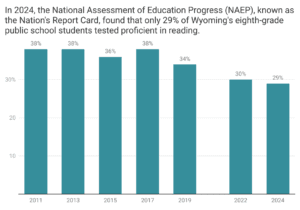
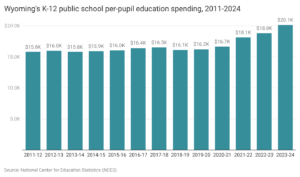
Honor Wyoming conducted a statewide parent poll on public education, asking families to grade their public school experience on important criteria like curriculum quality, parent communication, career readiness and whether their values are respected in the classroom. Hundreds of families across Wyoming participated in our survey, providing us with valuable insights into what was driving this poor grade. There is much to be said about the fact that K-12 education spending in Wyoming has increased by 27% between 2011 and 2024, while reading proficiency has declined by 24% during the same period.
However, parents have numerous other concerns about Wyoming’s public school system.
Here’s a look at the Top 4 Issues reported by Wyoming families, including their feedback about the root causes as well as potential solutions.
1. Bloated, Unresponsive Administrative Class and Poor Leadership
Parents are viewing education through a different lens than they once did and are increasingly concerned about a bloated, unresponsive administrative class in Wyoming’s education system. School administrations are increasingly being seen as disconnected and ineffective. Administrative costs have ballooned and families have become aware of this fact as property taxes and school budgets continue to skyrocket while test scores and responsiveness to parents decline. Reaching out and getting a solution to their concerns has become next to impossible because parents are continually handed off to the next layer of an ever-growing bureaucracy. They complain of navigating through layers and layers of administration and not feeling heard. It’s equally frustrating to see this bureaucratic bloat and apathy when they understand teachers are overworked and salaries have remained stagnant (only going up 5% in over a decade). It’s no secret that administrative budgets divert resources from core educational functions, a view echoed in Wyoming’s push for transparency, as outlined in the recent Wyoming Department of Education’s 2024 Strategic Plan. The correlation between increased administrative positions and unresponsiveness to parents’ needs could not be more obvious.
Parents want leaders who listen and act decisively, not administrators who insulate themselves from accountability. The issue is significant because it erodes confidence in the ability of staff to serve students, families, and communities effectively.
The type of solutions parents suggested to address this issue included:
- Cutting administrative bloat
- Establishing a type of Parental Rights Commission that works with the Wyoming Department of Education to oversee administrative accountability and address local control failures.
- A formal parental grievance process that would allow parents to file actionable complaints when boards or administrators prioritize their agendas over student needs, ensuring justice and aligning resources with community values.
- Misallocated Resources and Overburdened Teachers
Parents in Wyoming are frustrated that, despite the state spending approximately $26,000 per student in the 2024-25 school year (one of the highest rates in the nation according to the National Center for Education Statistics), teachers are not seeing proportional benefits in their classrooms to these increased budgets. All the while, student proficiency in core subjects like math and reading continues to disappoint. The Wyoming Department of Education reported in 2024 that only 54% of students met proficiency standards in reading, down from 56% in 2019, despite a 22% increase in per-pupil spending since 2020.
Parents point out that teachers are increasingly tasked with roles beyond education, such as acting as nurses and mental health counselors, which dilutes their focus on teaching. Teachers are also having to fulfill burdensome requirements to receive funding from grant programs, diminishing class instruction time. This misallocation of resources and responsibilities is driving teacher burnout, with a 2023 Wyoming Education Association survey noting that 65% of teachers considered leaving due to overwhelming non-instructional demands, not just salary concerns.
This issue is of great importance to parents because education should prioritize student learning, and teachers are most effective when focused on their core purpose: imparting knowledge. When resources are diverted to non-educational roles or administrative overhead & non-essential expenditures, classrooms suffer and teachers are unfairly burdened. Schools must refocus on academic fundamentals to improve outcomes, a view shared by parents who want teachers empowered to teach.
The type of solutions parents suggested to address this issue included:
- Redirecting funds to classroom essentials, such as updated materials and support staff to relieve teachers of extraneous duties.
- Schools should not be trying to take a primary role in addressing the health, counseling, or social needs of children.
- Fatigue with Social Advocacy and Indoctrination
Parents across Wyoming expressed a collective exhaustion with what they perceive as social advocacy or indoctrination in schools, particularly around political or social issues like critical race theory or gender ideology, and now the new catch-all programs called Social Emotional Learning. Even though Social Emotional Learning is being touted as a mental health solution, upon examining actual surveys and courses to which their kids are being exposed, it appears to be another tool that could turn into pushing political and social agendas that have no place in our public schools.
This seems to be a shared sentiment that curricula are pushing ideological agendas over objective education, as seen in national debates where 17 states, including Tennessee, have restricted discussions on race and gender since 2021. This matters because parents believe schools should focus on equipping students with basic skills (reading, writing, math), not promoting divisive ideologies, which they fear undermines families and academic rigor.
The concern is rooted in a desire for education to remain neutral, fostering independent thought rather than conformity, and a return to classical education, which emphasizes core subjects and universal values over activist curricula.
The type of solutions parents suggested to address this issue included:
- Parental oversight through curriculum transparency laws, allowing parents to review all materials their children will be using.
- Schools could adopt apolitical standards, focusing on math, reading, and civics, as suggested by the 2024 strategic plan.
- Ensuring education serves all students while respecting family values.
- Ineffective Discipline Policies and Disruptive Behavior
Parents are alarmed by lax discipline policies that fail to address disruptive students or bullies, creating unsafe and chaotic classrooms. The National Center for Education Statistics reported in 2024 that 19% of Wyoming students experienced bullying, with only 44% of incidents reported to adults, suggesting weak enforcement. Parents cite examples of unchecked classroom disruptions, with a 2023 NEA survey noting 68% of Wyoming teachers faced verbal abuse from students monthly. This matters because disruptive behavior hinders learning and safety, leaving parents feeling schools prioritize leniency and “passing on” a student over accountability, eroding trust in the system’s ability to protect their children.
In this increasing culture of leniency, parents are starting to see failures that address escalating disruptions. The leniencies in our current school districts are seen as major contributors to a climate where students are being bullied, children are learning there are no consequences for being a bully, and children are being handed an enormous hindrance by the education system because feelings are taking precedence over becoming a functioning member in society. They are frustrated that the feelings of a few have trumped the safety of the many.
The issue is critical as it affects every student’s ability to learn. Parents argue that clear boundaries and consequences foster respect and order, but they feel that this is lacking more and more. Many parents feel there is a lack of authority in the classroom, coupled with administrative inaction. A lack of commitment to order and accountability in the classroom is making it very hard to build a culture of responsibility and ensure classrooms are safe and conducive to learning.
The type of solutions parents suggested to address this issue included:
- A Teachers’ Bill of Rights that would help manage classrooms by granting authority to remove disruptive students
- Discontinue the practice of allowing the feelings of a few to be prioritized over the safety and educational needs of the many.
- A formal parental grievance process that would allow parents to file actionable complaints to protect against administrative inaction